
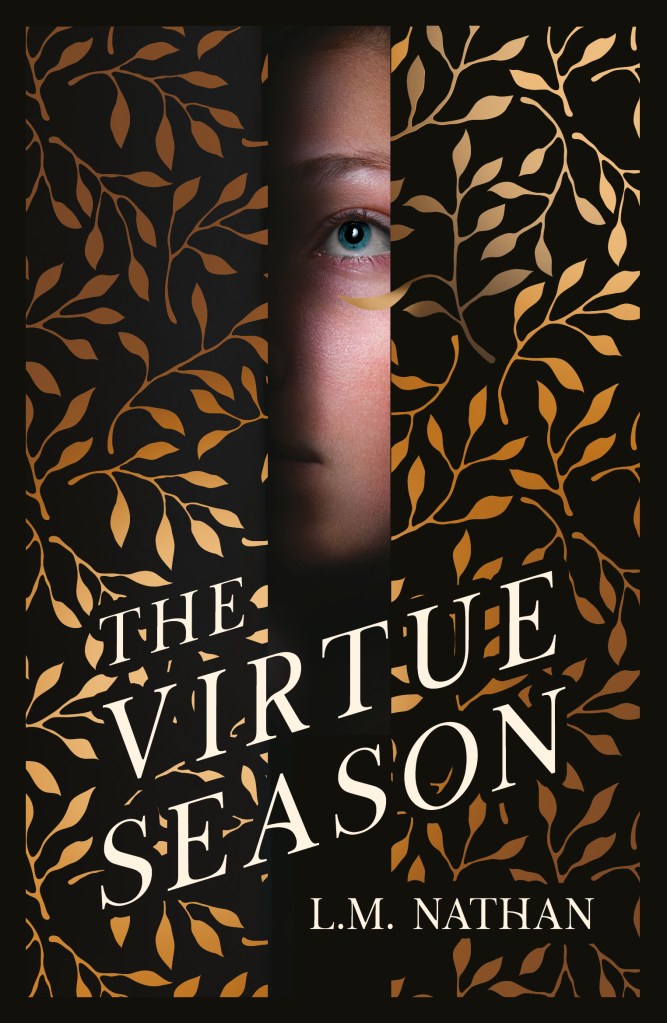
L.M. Nathan chats about her debut YA The Virtue Season, a dystopian novel which combines elements of Bridgerton, The Hunger Games and The Handmaid’s Tale.
Could you introduce us to your novel, The Virtue Season?
The Virtue Season is the story of Manon – a debutant who wants nothing more than love, but love is also the thing that terrifies her the most. Now that she is eighteen, and about to attend the virtue season balls, it is tantalisingly close. At the end of the season, she could have found the one – if her match is sanctioned by the council. But she lives in a world that holds some very spurious beliefs as truth, a world where genetic flaws are feared, and it is believed that bloodlines must be pure. And Manon is hiding a secret about her family that would be viewed as a defect. If it is discovered, Manon will be decommissioned. She will not be allowed to marry, or to have children, and will live as an outcast with her future decided by the oppressive council… just like her best friend Agatha.
The novel deals with a lot of important (and difficult) themes and topics, including women’s rights and inclusivity among others. Where did the inspiration come from for this story?
Growing up I never really felt I fit anywhere. It took me a long time to realise that’s how most people feel – regardless of how confident they seem or how much they appear to be winning at life. When I was teaching, I saw it all the time, that feeling of being different, of being wrong in a world full of rights and I wanted to write something that was a clarion call to young people to shout: you do not define me, and, hopefully, to believe it too.
Like Manon, I felt from a young age my tendency for interiority and reflection might become something more insidious later in life, and I have had my struggles with anxiety but, also like Manon, I am strong and resilient and never give up. So it’s fair to say, she was inspired by own experiences.
I didn’t realise it when I was writing, but I was also weaving my dad’s experience into the story through the decoms. I would describe my dad as extremely able-bodied, if that is a thing. He was the kind of dad who threw you over one shoulder and carried you around giggling or launched you across the swimming pool, further than anyone else’s dad could. But then he was struck with illness and left disabled and though it didn’t change him – or his spirit – one bit, I saw how it changed the way society viewed him.
… I like the way the story reveals itself to me through writing. There’s a magic to it. The story becomes a living, breathing thing and it takes me with it.
The worldbuilding in this novel is brilliant! Did you plot this beforehand, or did the world reveal itself as you wrote? The setting is also so vivid. Is it based on any real places?
I’m not a plotter. I tend to have a general gist of where the story will go and some sense of the main beats within it, but I like the way the story reveals itself to me through writing. There’s a magic to it. The story becomes a living, breathing thing and it takes me with it.
Calde Valley was inspired by the Ribble Valley, which is every bit as majestic as it appears in the story. Shortly after I moved there, it flooded and I found myself standing at the top of Clitheroe Castle, on a very windy, rainswept day, staring out at Pendle Hill and wondering…what if? Most people who are inspired by Pendle Hill tell stories about witches, but I managed to turn it into an apocalyptic dystopia.
Manon and Agatha are such brilliant characters and their friendship goes through such a journey. What tips do you have for aspiring writers creating their own characters?
My experience of finding Manon and Agatha verges on the supernatural. Once I had the setting of Calde Valley, they seemed to wander onto the hillside, take a bow and introduce themselves. I’m not a fan of character development exercises – what’s in their handbag and so on – but I know lots of writers swear by them. Because this was my first book, and I was finding my way, I did do this for Manon but very little of it was used. I think the only thing I kept from those types of questionnaires was her most treasured possession, which was her grandmother’s recipe book, which gifted me her cooking ability. So, I suppose it was worth doing but I prefer to tease out character through writing exercises. I might write a scene from a different character’s point of view and watch as Manon or Agatha reveal themselves through observation. I wrote lots from the perspective of Councillor Torrent and some from Wick’s as well. It allowed me to watch the two girls rather than being in their head all the time. Another great exercise is to put your character in a scene ‘outside’ the story – perhaps as a child or reflecting later in life, or in a location they don’t visit as part of the story. That’s always revealing, and no writing is ever wasted, even if it doesn’t make it into the book.
This is your debut YA. Have you learnt anything you wish you’d known beforehand? What has been the most enjoyable part of the process (and, conversely, what has been the least enjoyable)?
Looking back, I wish I’d understood how much of the ‘writing’ happens after the first draft is finished. I wouldn’t have procrastinated over that draft for so long if so, but it felt like the stakes were high and I put it off for a lot of years.
Without a doubt, the most enjoyable part of this process has been meeting other people going through the same thing, discussing plot and character and motivation and all things bookish. It might seem strange, but the moment of publication has been the least enjoyable part. Sharing this story, which has been such an important part of my life, is scary and vulnerable and surreal. I have to hold fast to my own belief that the story is good.
This is a world we’d love to revisit, and it definitely feels like there is more to come for these characters. Are you planning any more novels in this world?
I could go on writing about these characters forever. There is so much more for Manon and Agatha to accomplish. Real change happens slowly and, without giving away any spoilers, it didn’t feel right to gift them utopia at the end of this book and so, there is unfinished business, I think. There are also characters whose backstories I’d love to explore – Torrent, Drewis and Trent, Gillam and Cayte. And there are the stories that represent Calde Valley’s future too. Agatha’s sister Wren pleads her case often. Even Bertie, who I think is brave and dear and understated. They have so much life yet to live in my head.

L.M. Nathan
L.M. Nathan grew up in the East Midlands, moving from there to Bristol where she studied English and Drama and then to Malta where she completed an MA in Literature. She also has an MA in Journalism which she studied for in Manchester. She now lives in rural Lancashire, in the shadow of Pendle Hill, and teaches English.
Her first novel, The Virtue Season, was inspired by the wild landscape of home and completed when she was selected to be part of the Curtis Brown Creative novel course.
The Virtue Season is published by Scholastic and is out now.

 PaperBound Magazine