article, Blog, Blog series, Bookshelf, Interview, Interviews, on writing, Writing craft

Interview: Best of All Worlds by Kenneth Oppel

It’s a survival thriller in which Xavier, my teenaged hero, wakes one morning to find that his family’s lakeside cottage has been moved somewhere completely different. When he, his father, and heavily pregnant stepmother go to explore, they find themselves on a farm – hens, two Nubian goats, thriving crops! When they wander further, they realize they’re trapped inside a dome.

I wondered how people would react to finding themselves in an inexplicable situation – what kind of story you’d need to tell yourself to make sense of it, what your plan of action would be. I also wrote the novel because I was fed up with conspiracy theorists, science deniers (especially deniers of climate change), and people who mangled the concept of freedom to justify hate, racism, and blatant self-interest. The world is hard enough for adults to navigate; for kids it must be even more bewildering, being deluged with misinformation.

Oh yes! I learned a lot about sustainable farming, the best kind of milk goats to get (also how to breed, castrate and butcher them). I read about the best time to plant certain crops and harvest them. I went down way to manner research rabbit holes. I also, sadly, had to research various conspiracy theories and the people who perpetrated them.

I am a big plotter and planner, and spend a lot of time “daydreaming” the world of the story before I start chapter one. But during the writing there are always delightful surprises. The biggest was probably the decision to introduce another family into the dome, one that had vastly different values than the first.

Usually the concept or setting. Best of All Worlds was definitely concept; books like Airborn and The Boundless were the settings.

Don’t expect it to be perfect the first time. If you get stuck somewhere in the story, jump to another place. Get as much feedback as possible from trusted readers.

Having a book in outer space. Airborn went to the ISS for six months with Canadian astronaut Robert Thirsk, and I got to meet him afterwards, and see my space book – though sadly they didn’t let me keep it!

I have a couple novels vying for attention at the moment. One involves U-Boats, the other a young rock band behaving badly.

Kenneth Oppel is the bestselling author of many books, including Airborn, which won the Governor General’s Award for children’s literature and a Michael L Printz Honor Book Award, and the Silverwing trilogy, which has sold over a million copies worldwide. Some of his other books include Ghostlight, The Boundless, Every Hidden Thing, and Inkling. The Nest and Half Brother both won the Canadian Library Association’s Book of the Year for Children Award. Kenneth lives in Toronto with his family.

PaperBound Magazine is an online magazine and blog for the young, and the young at heart. We are dedicated to showcasing authors and illustrators for children’s and young adult fiction and we strive to deliver inspiring content, uplifting stories, and top tips for young and aspiring writers yet to burst on to the literary scene.

All our issues are completely free and run by volunteers, however if you would like to support PaperBound and the work we do, you can help us out by buying us a virtual book. We appreciate any support you can give us!

Don’t forget you can read with the latest issues of PaperBound Magazine – completely free – here.

Island of Influencers by Monique Turner
article, Blog, Blog series, Bookshelf, Interview, Interviews, on writing, Writing craft

Interview: Island of Influencers by Monique Turner

I’m a curious person by nature, and the concept of influence is something I’ve studied in depth. What makes this person’s message so hard to ignore? Why have the masses flocked to this ideology? I can’t rest until I find an answer, and this research is what led me to helping create informative videos on YouTube. The realms of social media are the perfect place to observe human behaviour, especially in regards to influence.

I started working behind the scenes of YouTube channels as both a personal assistant and a scriptwriter, and I was lucky enough to witness influence from inside the fishbowl. Suddenly, I had access to the private aspects of human behaviour through direct messages and emails, and it was fascinating to learn how many people wanted to live the influencer lifestyle and, in contrast, how many people had absolute disdain for anyone who did.

I began writing Island of Influencers as a way of responding to the desires of the masses on the outside looking in, and to process everything I was part of. Harper, my protagonist, is a reflection of all the people wanting to be inside the influencer world – yearning, desperate and naive. Belle, her famous cousin, is the antithesis of that fairytale – she’s the harsh reality that Harper refuses to see until it’s too late for both of them.

Island of Influencers is the result of years of social media observation and study of human behaviour, broken down into a fun, bite-sized concept that can be consumed by anyone who is remotely interested in internet culture.

Thank you! I had so much fun creating my characters, including their usernames, Tubeify channel niches, and even their channel logos.

Readathorien is my personal favourite! Obviously, I’m a huge book nerd, and I often consume booktube, booktok, and bookstagram content, so her username had to reflect her online niche. The username Readathorien is based off the viral fantasy series A Thorien of Witchers (a fictional book I created for my world), and her channel on Tubeify was started based around this series, so her fanbase is the same fanbase for the book series. Her username was birthed from the concept that art breeds more art, and I live for art that transcends its original format, when the work takes on a life of its own and the fans create new space for it all over the web to theorise about and build upon the lore.

Sssiguard has a reactions channel on Tubeify. His username is based off the Scandinavian name Sigurd, derived from the Old Norse name Sigurðr which means “victory” and “guardian”. From the get-go, Sssiguard sees himself as the victor, even before the competition has begun, and the triple ‘S’ comes from the sound made by a snake. Sssiguard’s actions in the book can be very sssnake-like. I changed ‘gurd’ to ‘guard’ because I wanted to emphasis that he sees himself as the guardian of his internet niche. In his eyes, reactions are his territory (proven in the Cancelled Club challenge).

Unlike Readathorien’s username, which is based off her niche, I wanted Sssiguard’s to be based off his personality.

Kottage Kay’s username is interesting, because how lucky is it that she has a name (Kay) that, when paired with a slightly altered spelling of cottage, so perfectly fits with her cottagecore channel niche! It’s almost like it was given to her by the gods, manufactured in some way, like she’s an industry plant destined to succeed in whatever she does. Who knows!

Absolutely! The Hunger Games is a series that captivated me when it was first released. I couldn’t help but compare it to my own world. I can see the parallels even clearer now as I grow older, and for me, the internet is a very dystopian place, so merging the two concepts together just worked.

Obviously, my main inspiration was YouTube, specifically large-scale competition games with huge stakes and disgusting sums of money to be won. That’s the foundation of the novel.

But this book was also inspired by George Orwell’s Nineteen-Eighty-Four, Joseph Heller’s Catch-22, and Ray Bradbury’s Fahrenheit 451. All of these books deal with censorship, how easy it is to influence a society, control through media, getting stuck in systems that benefit only the rich and powerful, and how certain tools and technologies can be used to distract the masses from the realities of the world.

Music has also inspired many of the stories I’ve written, Island of Influencers included. This one is hard to explain, but sometimes I just stumble upon a song and something about the musical composition or the lyrics just invokes this whirlwind of activity in my brain. In the duration of that three minute song, I can create an entire world and storyline based on the vibe, and then magic just happens.

While writing the beginning of Island, I listened to loads of songs where the lyrics focused heavily on success, status and money, but I then switched to cinematic, epic instrumental pieces as I transitioned into act three, which really helped to unfurl the humour of the novel and reveal the darkness hidden beneath.

It’s already changing, without a doubt! Technology has advanced so rapidly within the span of my own lifetime, and today the changes are almost daily. Trends come and go quicker than you can jump on the bandwagon, the algorithms switch-up before you can even figure them out, and the days of old-Hollywood celebrity have been replaced by overnight successes who fade from relevance just as quickly as they appeared on our screens.

The internet has become an uncontrollable beast and people are tired. We’re overwhelmed with content now and it’s getting harder to discern what is genuine, relatable content, and what is actually marketing and promotion disguised as genuine, relatable content. There’s been a radical change in how people engage online, there’s less connection between creator and consumer and we’re seeing a rise in passive lurking and low conversion rates from views to shares, comments and likes on all forms of content.

People looking to become content creators or influencers are trying to go too big too soon these days, everyone wants their first video/ book/ song/ post to be a viral hit, and to gain millions of followers and subscribers overnight. That isn’t sustainable, and we’ve seen evidence of that through those who have gone viral overnight and then fallen short because they have no catalogue behind them to be able to keep the momentum going.

Personally, I think we need to go back to the drawing board and remember what made the early days of social media so great. The audience doesn’t want to be mindlessly sold to, they don’t want to feel like a number on a page, or like they’re the product of a strangers empire. People want to feel seen and valued by the creators they follow. There’s no better feeling than watching your favourite content creator rise from nothing into the stratosphere, to feel like you’re part of something that others on the outside don’t understand. 

My best advice to anyone who wants to become a content creator is this: don’t aim to grow a fanbase, aim to create a community of like-minded people. That might mean that you start with two of your mates engaging with your stuff, and then a third and fourth person might find you organically, and then soon you’ll have ten people engaging with your content, and then fifty. It’s the snowball effect. It’s slow and frustrating, and the outer shell might flake away and change, but the core is solid.

I’m looking forward to the days of social media where creators are focusing on community again, and not just spewing out content for the sake of making a profit.  

The ending was my favourite part to write, simply because I knew it would throw people for a loop. To me, the whole novel is obscure, but the darkness in the first three-quarters is blanketed by humour and absurdity which puts the reader at ease, and when that blanket is lifted toward the end, it’s unsettling. It comes across as quite jarring, but the darkness was always there.

I mentioned in a previous answer that I was inspired by Joseph Heller’s Catch-22. I love how Heller used satire to draw attention to and criticise certain aspects of society and human behaviour. It’s the same tactic a magician uses, a slight-of-hand trick. 

In Island of Influencers, I said, “Look over here at this ridiculous, entertaining thing while I do something underhand in the shadows,” and then by the time the reader and the characters notice, it’s already too late. The seeds were sown from the first page and, in the end, we all must reap what we sow. 

Funnily enough, this is also a tactic used by those in power in our real world. What’s the best way to assert control over the masses without anyone noticing or putting up a fight? Distract the people elsewhere.

And as for Harper, does she regret becoming an influencer in the end? I think that’s open for interpretation. She got everything she ever wanted, her dream came true after years of trying to make it happen, but it came at a cost. Only the one who pays the price can decide whether it was worth it.

Personally, I would never want for myself what she now has. 

Some readers might feel cheated by the end, because of how obscure it is. But my intention was never to make the reader feel comfortable, but to show how easy it is to be deceived, even when you have all the clues laid out before you.  

I have just handed in book two of the Influencer series to my editor, and I’m super excited to dive into edits for this one. It follows different characters in the same world, trying to navigate social media in the days following book one. We do also get to see what happens to some of the characters from Island of Influencers, and you may be surprised by where they’ve ended up.

For now, that’s all I can say, but I will leave you with this little snippet that I think captures the vibe of book two perfectly: “Are you entertained yet?”
Monique was born and raised in the cold north of England on a diet of strong brews and thick gravy. Whilst growing up, she struggled to find her place in the world, so she vowed to create stories where those who don’t fit in can finally feel like they belong. When T.M. Turner isn’t writing, she can be found roaming the southern coast.

PaperBound Magazine is an online magazine for the young, and the young at heart. We are dedicated to showcasing authors and illustrators for children’s and young adult fiction and we strive to deliver inspiring content, uplifting stories, and top tips for young and aspiring writers yet to burst on to the literary scene.

All our issues are completely free and run by volunteers, however if you would like to support PaperBound and the work we do, you can help us out by buying us a virtual book. We appreciate any support you can give us!

Don’t forget you can read with the latest issues of PaperBound Magazine – completely free – here.

Blog, Blog series, Bookshelf, Interview, Interviews, on writing, Writing craft

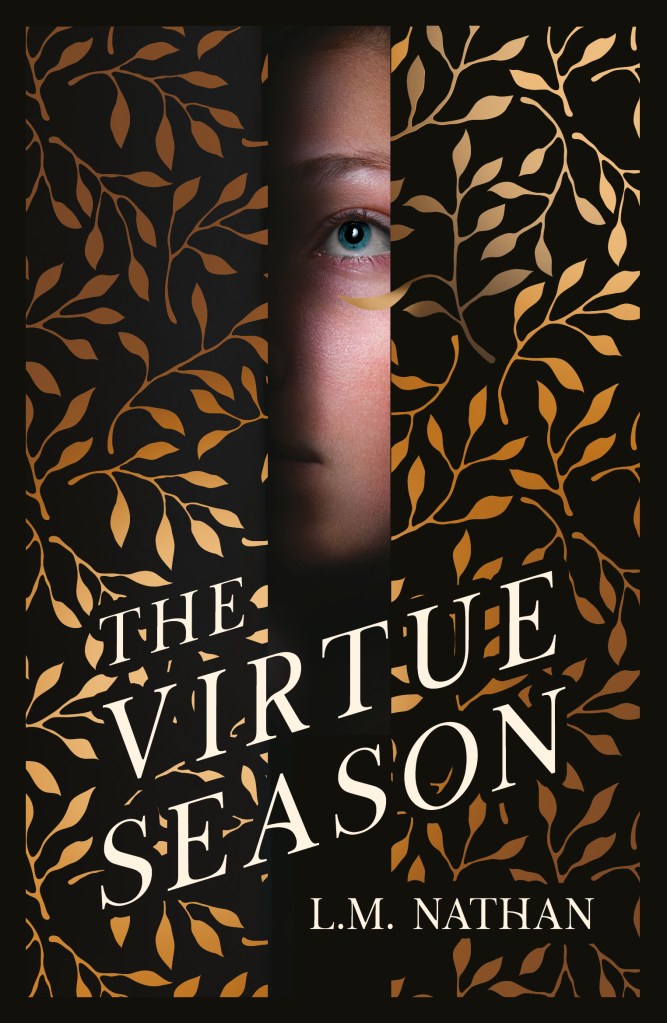
Interview: L.M. Nathan speaks to PaperBound about her new YA dystopian novel ‘The Virtue Season’

The Virtue Season is the story of Manon – a debutant who wants nothing more than love, but love is also the thing that terrifies her the most. Now that she is eighteen, and about to attend the virtue season balls, it is tantalisingly close. At the end of the season, she could have found the one – if her match is sanctioned by the council. But she lives in a world that holds some very spurious beliefs as truth, a world where genetic flaws are feared, and it is believed that bloodlines must be pure. And Manon is hiding a secret about her family that would be viewed as a defect. If it is discovered, Manon will be decommissioned. She will not be allowed to marry, or to have children, and will live as an outcast with her future decided by the oppressive council… just like her best friend Agatha.

Growing up I never really felt I fit anywhere. It took me a long time to realise that’s how most people feel – regardless of how confident they seem or how much they appear to be winning at life. When I was teaching, I saw it all the time, that feeling of being different, of being wrong in a world full of rights and I wanted to write something that was a clarion call to young people to shout: you do not define me, and, hopefully, to believe it too.

Like Manon, I felt from a young age my tendency for interiority and reflection might become something more insidious later in life, and I have had my struggles with anxiety but, also like Manon, I am strong and resilient and never give up. So it’s fair to say, she was inspired by own experiences.

I didn’t realise it when I was writing, but I was also weaving my dad’s experience into the story through the decoms. I would describe my dad as extremely able-bodied, if that is a thing. He was the kind of dad who threw you over one shoulder and carried you around giggling or launched you across the swimming pool, further than anyone else’s dad could. But then he was struck with illness and left disabled and though it didn’t change him – or his spirit – one bit, I saw how it changed the way society viewed him.   

I’m not a plotter. I tend to have a general gist of where the story will go and some sense of the main beats within it, but I like the way the story reveals itself to me through writing. There’s a magic to it. The story becomes a living, breathing thing and it takes me with it.

Calde Valley was inspired by the Ribble Valley, which is every bit as majestic as it appears in the story. Shortly after I moved there, it flooded and I found myself standing at the top of Clitheroe Castle, on a very windy, rainswept day, staring out at Pendle Hill and wondering…what if? Most people who are inspired by Pendle Hill tell stories about witches, but I managed to turn it into an apocalyptic dystopia.

My experience of finding Manon and Agatha verges on the supernatural. Once I had the setting of Calde Valley, they seemed to wander onto the hillside, take a bow and introduce themselves. I’m not a fan of character development exercises – what’s in their handbag and so on – but I know lots of writers swear by them. Because this was my first book, and I was finding my way, I did do this for Manon but very little of it was used. I think the only thing I kept from those types of questionnaires was her most treasured possession, which was her grandmother’s recipe book, which gifted me her cooking ability. So, I suppose it was worth doing but I prefer to tease out character through writing exercises. I might write a scene from a different character’s point of view and watch as Manon or Agatha reveal themselves through observation. I wrote lots from the perspective of Councillor Torrent and some from Wick’s as well. It allowed me to watch the two girls rather than being in their head all the time. Another great exercise is to put your character in a scene ‘outside’ the story – perhaps as a child or reflecting later in life, or in a location they don’t visit as part of the story. That’s always revealing, and no writing is ever wasted, even if it doesn’t make it into the book. 

Looking back, I wish I’d understood how much of the ‘writing’ happens after the first draft is finished. I wouldn’t have procrastinated over that draft for so long if so, but it felt like the stakes were high and I put it off for a lot of years.

Without a doubt, the most enjoyable part of this process has been meeting other people going through the same thing, discussing plot and character and motivation and all things bookish. It might seem strange, but the moment of publication has been the least enjoyable part. Sharing this story, which has been such an important part of my life, is scary and vulnerable and surreal. I have to hold fast to my own belief that the story is good.

I could go on writing about these characters forever. There is so much more for Manon and Agatha to accomplish. Real change happens slowly and, without giving away any spoilers, it didn’t feel right to gift them utopia at the end of this book and so, there is unfinished business, I think. There are also characters whose backstories I’d love to explore – Torrent, Drewis and Trent, Gillam and Cayte. And there are the stories that represent Calde Valley’s future too. Agatha’s sister Wren pleads her case often. Even Bertie, who I think is brave and dear and understated. They have so much life yet to live in my head. 

L.M. Nathan grew up in the East Midlands, moving from there to Bristol where she studied English and Drama and then to Malta where she completed an MA in Literature. She also has an MA in Journalism which she studied for in Manchester. She now lives in rural Lancashire, in the shadow of Pendle Hill, and teaches English.

Her first novel, The Virtue Season, was inspired by the wild landscape of home and completed when she was selected to be part of the Curtis Brown Creative novel course.

PaperBound Magazine is an online magazine for the young, and the young at heart. We are dedicated to showcasing authors and illustrators for children’s and young adult fiction and we strive to deliver inspiring content, uplifting stories, and top tips for young and aspiring writers yet to burst on to the literary scene.

All our issues are completely free and run by volunteers, however if you would like to support PaperBound and the work we do, you can help us out by buying us a virtual book. We appreciate any support you can give us!

Don’t forget you can read with the latest issues of PaperBound Magazine – completely free – here.

Blog, Blog series, Bookshelf, Interview, Interviews, Writing craft

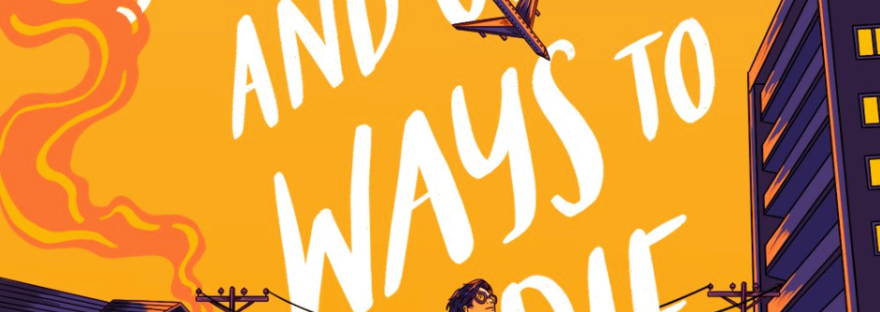
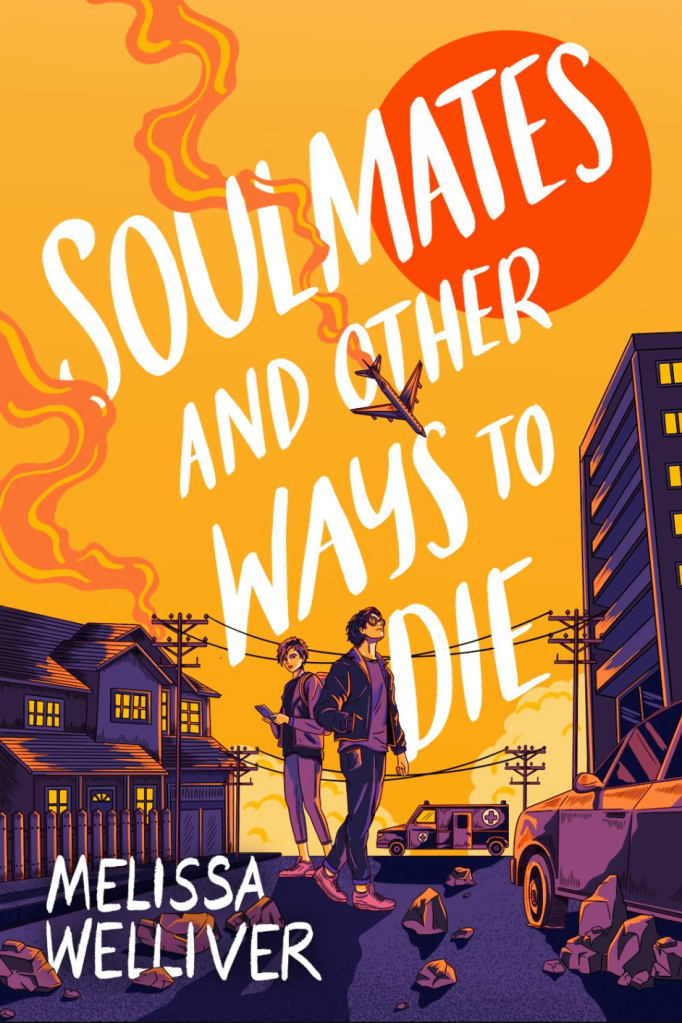
Interview: YA author Melissa Welliver chats about her new dystopian romcom ‘Soulmates and Other Ways to Die’

Of course! My name is Melissa Welliver and I write speculative novels, most recently dystopian YA with a dash of romance and comedy. I live in the North of England with my dogs and I run a community online for kidlit writers called the WriteMentor hub. I am also a co-host of The Chosen Ones and Other Tropes, a podcast based around trending tropes in commercial fiction.

This story was actually born from playing online games in a team arena. One game I played had a rule where if one member of the team took damage, the whole team lost health points. And I thought, what a fun idea to bring into the real world! I love a dash of romance in everything I write, and I thought this specific idea would work really well in the exploration of the Soulmate trope. In Soulmates, if you feel pain, so does your significant other. And if they die… you die too.

For anyone who hasn’t read the book, there is an app mentioned that can match you to your soulmate. This is partly practical as it’s good to know who the other person is that could possibly, accidentally, kill you, but also it’s essentially a dating app – but with all the choices removed. Imagine that there is no swiping right or left – there’s one answer, and that’s who you are tied to forever. Nightmare! To be honest, many elements of the app were inspired by the NHS covid app that would register whether you were vaccinated and whether you had been in close contact with someone who had tested positive. I wanted to ask the question: is it a good thing to track ourselves so closely? Can there be good and bad elements to these sorts of closely tracked government apps?

As for my own apps, I’ve turned off all my notifications on my phone, so for my social media, I have to open the app to see if I’ve had any messages. I find this stops me checking my phone so much when I’m out and about in real life with friends! But my favourite app, as a bit of a prepper myself, is what.three.words. It’s an app that can pinpoint your location to a 3m by 3m area, no address needed, with three simple words. Very helpful in an emergency to let people know where you are – just because I’m paranoid, doesn’t mean I’m wrong!

So obviously, the correct answer is, of course not! But if Argo Duff, the eccentric billionaire app owner who bought a social media franchise and has some interesting dating habits, and is a little more than a bit controlling, reminds you of anyone… then that’s on you.

Ah, I love dogs too, they absolutely count! But aside from doggo pals – I’m very much someone who believes we make our own luck and destiny in life. A soulmate is whatever we make of it – in the book, I was keen to explore the concept of choice versus control, and whether having a soulmate thrust upon you – until death do you very literally part – are they truly your soulmate anyway? I also wanted to explore different types of love – platonic love, familial love, asexual love, romantic love – who says a soulmate has to be what dating apps tell us they are? There are many different kinds of love, and soulmate means something different to everyone. So are soulmates real? Maybe. Read the book to find out.

Honestly, I’m not as fit and prepared as Zoe in the novel, who is a world class doomsdayer, but I’d like to think I’d have a chance of not going out in the first wave of whatever it is taking us out! I carry around a rechargeable battery pack, plus some gadgets like trackers that I allow my family to follow so we would always know our last movements in an emergency. My Dad is from LA, so he also gave me an emergency earthquake kit when I went to uni (in deepest darkest Leeds. Earthquake central, of course) that consisted of a torch, matches, spare batteries, all sorts of stuff. So even though I might not be the classic bad-ass female cutting my way through the hordes of zombies, I think I could find a pretty good place to hide until it all blows over.

Sure! So it’s become a bit of a tradition now for me to write a novel in the month of January. I plot incessantly, so I use the more conventional NaNoWriMo (when a lot of writers write a novel in a month!) to plot each chapter of the book, and then have a break in December before coming back in January to write it. I write for 2 hours a day, between 10am-12pm, in concentrated writing sprints, and that usually nets me a chapter, or 3000 words. I’m not allowed to read back what I’ve written, or pause writing during the sprints, even if I’m getting stuck! It’s all about powering through to get that first draft down. And I usually write 25-30 chapters depending on the age range, so that gives me my month of writing quite neatly.

I have two books coming out this year, which is really exciting! Soulmates and Other Ways to Die is in March, and the re-release of my self-published book, The Undying Tower, is coming out with UCLan Publishing in August. While my Chicken House books all lean towards a slightly wacky take on the apocalypse, The Undying Tower is very much a dark dystopian in the same vein as The Hunger Games or Divergent, and is the first in a planned trilogy. I can’t wait to see what everyone thinks of the redesigned cover, and to reach new readers through re-printing this book baby of mine!

Don’t listen to advice! Just kidding – well, sort of. Follow your writing heart and don’t let trends get in your way. The books you see on shelves right now were written and negotiated years ago, so there’s no point jumping on a bandwagon if your heart isn’t in it, just because you think it will sell. Write what you love and it will come across in the writing, so readers will love it too. Also, don’t give up! It’s a long old road, publishing – you’ll get there. The only difference between a published author and an unpublished author is perseverance.

Melissa Welliver writes Young Adult Speculative novels. She works at WriteMentor and runs the Community Writing Hub for Children’s writers. She has two dystopian rom-coms, My Love Life and the Apocalypse and Soulmates and Other Ways to Die, published with Chicken House Books. The first in her dark dystopian trilogy, The Undying Tower, will be published by UCLan in August 2024.

She can be found across social media under @melliver, and on tiktok under @melissawelliver.

Like his career, Steve’s writing is filled with tech and engineering, although his speculative thrillers tend to have higher stakes and fewer meetings. Before working as a copywriter and editor, he was a consultant, a magazine editor, a communications director, a product designer and a webcaster, though not at the same time. Home is South London, where he lives with his wife and teenage daughters. They wish he’d stop saying, ‘What if…’

PaperBound Magazine is an online magazine for the young, and the young at heart. We are dedicated to showcasing authors and illustrators for children’s and young adult fiction and we strive to deliver inspiring content, uplifting stories, and top tips for young and aspiring writers yet to burst on to the literary scene.

All our issues are completely free and run by volunteers, however if you would like to support PaperBound and the work we do, you can help us out by buying us a virtual book. We appreciate any support you can give us!

Don’t forget you can read with the latest issues of PaperBound Magazine – completely free – here.