by Melissa Welliver
We are so pleased to share another wonderful article on writing, this time from Melissa Welliver whose books are already firm favourites with the PaperBound team. Here, join Melissa as she explores writing alternate histories when it comes to creating her own fiction.
What does studying the past tell us about the future?
A lot of people don’t know this but I did a joint-honours degree, and my final year was weighted one quarter towards English Literature, and the other three quarters towards History. That meant I ended up doing my dissertation on the Tudor period, which led me to the works of my favourite Tudor: Sir Thomas More. If you don’t know Thomas More and you love dystopia, well, listen up, because he invented it. Or at least, he coined the entire usage of Utopia in the first place, letting future writers subvert it for their own nefarious needs (read: writing a really cool story).
Thomas More’s Utopia – a falsified account of his journey to a seemingly perfect country named, you guessed it, Utopia – was arguably about an imagined, perhaps hoped for, future about how Tudor England and the world could run if we looked to a fairer, brighter future. The clue is in the title, but the people of Utopia were happy, balanced, had no need for money, and well cared for. So is it any wonder that when we as writers look into these topics, we end up imagining the worst possible scenario instead, to really show a mirror to the world we live in and discover what we truly see as Utopia?
So what does all this have to do with alternate histories? Well, just as Thomas More wrote about an alternate past, we do much the same when worldbuilding our dystopian futures. Most dystopias take route in a big change, something familiar to our own world but knocked off its axis with a cataclysmic event. This can be a change in our own pasts, such as in The Man in the High Castle, which imagines a world in which the Nazis won. The Fallout TV series and games are set in an alternate future where the timeline changes drastically after World War Two, to include vacuum tube electronics as opposed to circuit boards. Despite the diverges in these timelines happening in the past, Dystopias often seek to reflect what many decades of human endeavour past these points looks like in the future – and more importantly to the reader, whether we can stop them coming into being.
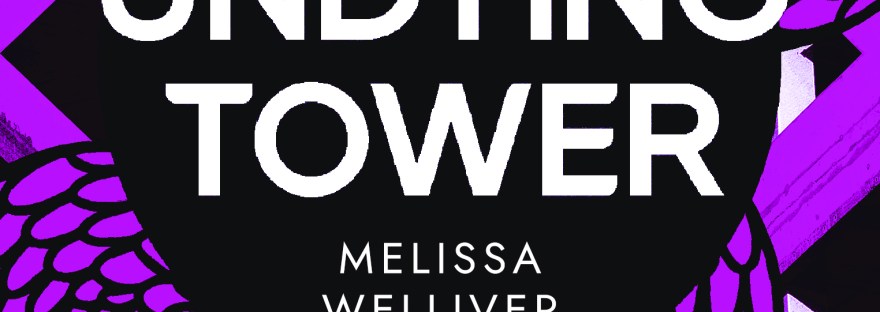
In The Undying Tower, I was most interested in exploring overpopulation and its effect on climate change. Because I knew how important these themes were up front, I was able to find SFF ways to incorporate them into the book during the early planning process. My lovely friend Caroline passed away from cancer (Glioblastoma Multiforme) during the writing process, and that made me really quite angry. All I could think about was what it would be like to live in a world where people don’t get sick, cancer was gone, and people lived forever. Caroline was a big believer in the planet we lived on, and I know she too was worried about the effects of overpopulation on climate change. And thus, the central idea of the book was formed. A small sect of society, known as the Undying, that could survive illness and never die from old age – and therefore inadvertently create an even bigger population boom.
… I even went on a trip to Chernobyl to fully understand the effects of nuclear power, especially on the environment when things go wrong (TLDR; the environment will eventually grow back, but the human outlook? Not great).
I knew I wanted to explore the accelerated effects of climate change after such a catalyst as the discovery of the Undying, so I knew I had to craft an alternate timeline where my book could take place. So despite being set in the future, I wanted it to take place decades into an overpopulation crisis, and see how that affected the world we live in now, to create my future one. I looked up flood maps for melted ice caps and food storage facilities in the UK. I even went on a trip to Chernobyl to fully understand the effects of nuclear power, especially on the environment when things go wrong (TLDR; the environment will eventually grow back, but the human outlook? Not great).
In essence, I truly believe that everything we learn about our history can help shape our futures. And writing alternate history can help writers explore broader themes in an evolved future, plus help readers to see the similarities in the world we live in. Writing alternate histories isn’t just for fiction – I hope it will help in reality, too.
Melissa Welliver
Melissa Welliver is a shortlisted author specialising in YA fiction. In the genre, she has produced two dystopian rom-coms, My Love Life and the Apocalypse and Soulmates and Other Ways toDie.
The Undying Tower is her first book in a trilogy.Melissa writes speculative fiction about how the end of the world is never really the end of the world. After studying Creative Writing at the University of Manchester, she went on to complete Curtis Brown’s Creative Writing for Children course. Her work has listed in Bath Novel Award, Mslexia, the Hachette Children’s Novel Award and the Wells Book for Children Competition.
The Undying Tower is published by UCLan and out now.
PaperBound Magazine is an online magazine for the young, and the young at heart. We are dedicated to showcasing authors and illustrators for children’s and young adult fiction and we strive to deliver inspiring content, uplifting stories, and top tips for young and aspiring writers yet to burst on to the literary scene.
All our issues are completely free and run by volunteers, however if you would like to support PaperBound and the work we do, you can help us out by buying us a virtual book. We appreciate any support you can give us!
Don’t forget you can read with the latest issues of PaperBound Magazine – completely free – here.


 PaperBound Magazine