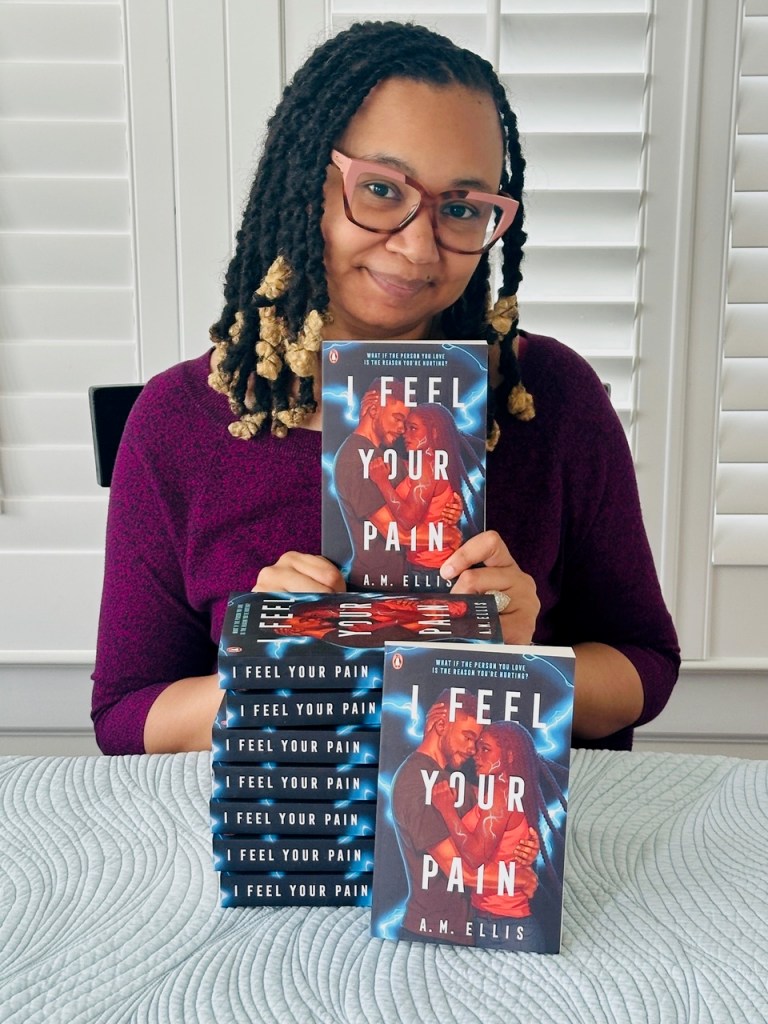
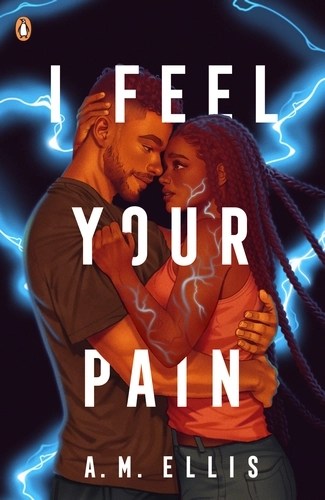
Author of I Feel Your Pain, A.M. Ellis, shares where the inspiration for her dystopian novel came from, and how writing dystopian fiction can open conversation to explore faults in our own society – and challenge them.
By A.M. Ellis
Dystopian novels have long been a way to have conversations about the state of our world, the past we left behind, and the threat of the future repeating mistakes erased and forgotten by history. This genre exists as a safe space to explore heavy topics. Books are meant to be a form of escapism and dystopias aren’t exempt. These fictional realities are often exaggerated depictions of our own lives, but the foundation is always familiar.
For some, reading Parable of the Sower by Octavia Butler feels like she glimpsed our future and left a warning. Handmaid’s Tale by Margaret Atwood could be a world one law away from our own with the present-day fight for body autonomy. And the increase of protests against broken governments could bring us to a brink where one cruel tyrant can have us living in The Hunger Games by Suzanne Collins.
These are fictional worlds thankfully. But there are lessons to be taken away, conversations to be had, all with the hope that young readers learn from them and hold on tight.
I Feel Your Pain is no different. It tackles themes still present today; classism, race, and systemic issues that dig themselves into the earth with thorny roots that twist and turn and refuse to let go. But before I dive deeper, let me set up a definition.
Systemic racism can begin as a rule or belief meant to openly oppress. Then over time as tides shift and society attempts to change and forget its roots, that rule or belief is rewritten to hide its intentions. Years pass and the original authors are gone, but this rule still exists because it serves as one function or another to a large majority. It’s part of our foundation. There’s no real need to correct it (sarcasm). It’s never truly evaluated (not sarcasm). And it comes with excuses –
“Oh, but we need that rule for societal order. It’s fine, it only hurts people who aren’t helping themselves. It’s not racist, it can affect anyone.”
Oftentimes it’s framed as though the removal of that rule will crumble the state of the world.
Will it though?
No. But it might crumble a few billion-dollar empires.
In I Feel Your Pain, I’m opening the door to have a conversation with readers. It’s a setting so close to our own – minus a cataclysmic solar flare. That solar flare brought with it a painful disease found in the majority of white people. But don’t worry, because scientists have found a way to help the affected through the Freedom System.
With the Freedom System, those with this disease can give away their pain to Pain Carriers, individuals with high pain tolerances who barely feel the ache of it. Of course, those Freedom System scientists have the research to back it up. Those Pain Carriers just happen to be made up of a majority of Black and Brown people.
This is where the conversation begins – the topic of discussion: pain and the stereotypes around tolerances in the Black community. This conversation didn’t come from thin air or a random thought of what-if. It has roots that have refused to dry up.
I Feel Your Pain … tackles themes still present today; classism, race, and systemic issues that dig themselves into the earth with thorny roots that twist and turn and refuse to let go.
Did you know that the “father of modern gynecology” achieved his success by – and I’m sugarcoating my words here – perfecting his technique on Black women in a way that ignored their pain? Those women, Lucy, Betsey, and Anarcha, were enslaved and used as variables in a science experiment, their humanity discarded.
I want everyone to know their story.
There’s a nod to them in I Feel Your Pain and I encourage you to look them up. Their survival and endurance are part of medical history. Let me repeat that one word: history. You would think that the disregard of Black pain and the belief of a mythical high tolerance ended here, but it doesn’t.
There are studies within the last ten years that show there are still non-Black medical professionals who believe there is a difference in how various races experience pain. You can find evidence of these beliefs when looking at labor and delivery mortality rates; Black mothers’ accounts of pain being ignored to the point of severe and fatal consequence.
I’ve heard too many accounts of Black voices ignored in the doctor’s office, and have personally experienced it. It left me in shock. It’s 2026. What Lucy, Betsey, and Anarcha endured – that was the 1840s.
The past shows us where these harmful stereotypes began and how they festered, the excuses that continue to be made. So when I wrote of a world with a painful disease and a society believing there are people and communities that can carry that pain with ease – there’s a history behind it. A history and a present I don’t want to see repeated in the next generation’s future.
These are the types of heavy topics dystopian literature allows authors to approach and address within the safe space of fiction. Readers can engage and draw parallels, open their eyes to things that should never happen, never be possible or believed.
Black people don’t have higher pain tolerances. The myth of thicker skin is, at most, likely rooted in a survival tactic required to navigate spaces built against a community that has done nothing to deserve this stereotype other than thrive against the odds. A quick nod to this – the Harlem Renaissance and the Great Depression happened at the same time. We feel, we hurt, we’re human. I need everyone to know and believe the truth.
So let’s have a conversation, and let dystopian literature once again do its thing. I can only hope for readers to take away the lessons to be learned, and hold onto them for as long as they can.
I Feel Your Pain is out now and published by Penguin
.
I Feel Your Pain
They were never meant to share a future – only the pain that connects them.
Ever since a cataclysmic solar flare struck 150 years ago, Helical Disease has plagued the city of Alta Bay. Those infected endure excruciating pain and a blue light that crackles beneath their skin. There is no cure.
However, Dominion Pharmaceuticals has created a revolutionary treatment that transfers the disease to people with unusually high pain thresholds. These Pain Carriers feel little to no pain, and they’re paid generously for their sacrifice.
Nova Williams is too focused on surviving to question the system. Castor Fox, heir to the Dominion empire, is proud of his family’s legacy.
When a chance road accident throws them together, the pair form an unlikely connection. But as they begin to fall for each other, a devastating truth comes to light: Nova is Castor’s Pain Carrier.
As darker secrets about the procedure emerge, Nova and Castor must decide whether to accept a broken world . . . or risk everything to change it.
A.M. Ellis
A.M. Ellis is a speculative fiction author and lover of everything steeped in myth and mystery. Her stories often lean into diverse voices, not only in her identity as a Black woman, but in exploring neurodivergence and mental health. A proud introvert and nostalgic gamer, she lives in Maryland, USA, with her husband and three children.