Blog, Blog series, Bookshelf, Interview, Interviews, on writing, Writing craft

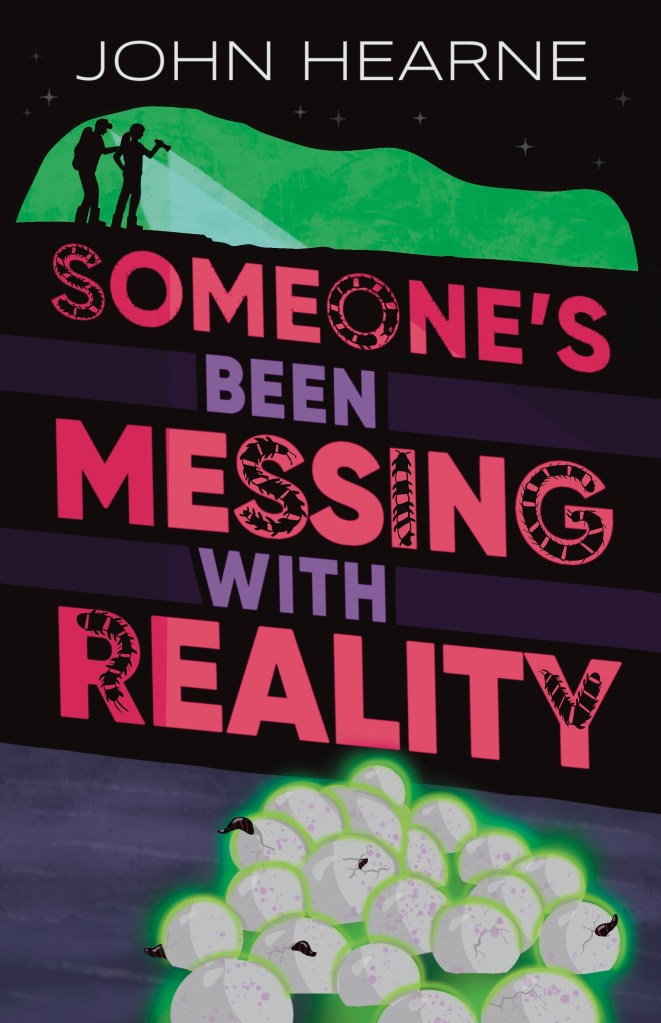
Interview: John Hearne chats about his speculative sci-fi novel ‘Someone’s Been Messing With Reality’ for middle grade readers

So here’s my tagline – ‘When Martin Ryan sees a video of his father flying unaided through the air, he realises that everything he has assumed about his life up to this point has been a lie’.

The whole novel arose out of the following proposition: ‘What if you were an alien, but didn’t know it?’ The moment Martin discovers the truth is also the moment that his parents disappear. He and his friends Tina and Enda realise that their disappearance is part of a larger conspiracy which they must unravel and thwart.

What inspired me to write it? I liked that proposition. Like a lot of writers, I log all the different story ideas that occur to me. Most of these ideas will never go anywhere, but if I hit one that’s sufficiently intriguing and exciting, I’ll start sketching out where I might go with it. What kind of characters could carry this kind of plotline? Where could I set it? Where will the intrigue come from? Once the ball gets rolling, it takes on a life of its own.

I’m a plotter and a planner. I like to work out where I’m going to go before I get there – but things always surprise you during the writing phase. I like to think of my outline as a map. I’m going to use it to get to where I’m going, but if I spot something interesting that doesn’t lie along the planned route, I’ll go explore it. The writing process tends to generate fresh ideas, and I think you’ve got to be open to evaluating them rather than sticking rigidly to the original plan.

Also, I often find as I write that that clever little plot detail or character quirk that I thought would work actually doesn’t, so I often stop midstream and rethink things. I find too that once you’ve established how a character acts, you’ve often got to give them more freedom that the original plot allowed. In Someone’s Been Messing with Reality, Martin’s friend Tina caused both him and me a lot of grief through her impulsivity – I had to keep readjusting things when I realised that ‘Hmmm, Tina would never do that…’

The process was similar, though it did have a lot more steps. I spent a lot of time figuring out exactly what would happen with Indigo before I dived into draft 1, but because this was my first attempt at anything like this, draft 1 was pretty much like the first chair that a trainee carpenter might make. The back was crooked and all the legs were different lengths. It went through several redrafts before I arrived at something that I would willingly show anyone – and the finished product didn’t bear much resemblance to the first draft. It’s true that most books aren’t written, they’re rewritten.

The Very Dangerous Sisters of Indigo McCloud had a fictitious setting – the absurdly miserable town of Blunt, and was choc-full of outlandish characters. I wanted to set Someone’s Been Messing with Reality in the real world, and make the characters a little more human. This is sci-fi – yes – but the relationships and problems and characters themselves are all real, or as real as I could make them.

Enda is one of the three friends at the centre of the book. He’s recovering from a brain injury. The emotional arc of the story rests on the different ways in which his two friends deal with this. I’ve always had an interest in brain injury. I made a radio documentary for RTE Radio 1 a few years ago about someone who was recovering from a very serious head injury. The weird thing is that after I had started work on this book, and after I had written Enda into it, I fell and hit my head. I gave myself what would be termed a ‘mild brain injury’. It may not have been life threatening, but it was very debilitating.

To cut a very long story short, I suffered from prolonged bouts of fatigue and could do very little work of any kind for a long time. Thankfully I’m fully recovered now, but the process took a couple of years. I couldn’t use a computer for much of that recovery. I had damaged the visual cortex at the back of the head, and my brain simply couldn’t deal with the kind of light that emanated from the screen. So much of this book was actually written longhand.

It has been lengthy! Much rejection, much rethinking, rewriting, repositioning. Getting published is hard and getting harder. This book – my second – was a little easier than the first, because I had a good relationship with the publisher, and they were happy to read what I wrote, but it had to reach a higher standard to get through. Rising costs have made it more difficult for independent publishers to take a chance on something, so they’ve got to love it before they’ll agree to put scarce resources on the line.

Since my book is science fiction, I’ll stick to that. My favourite in the genre is When You Reach Me by Rebecca Stead. A wonderful book, with a plot that rumbles slowly under the surface – you don’t quite realise that it’s sci-fi until close to the end. I also really like Ender’s Game by Orson Scott Card, the Dune books and The Iron Giant. My kids also love Hilo: The boy who crashed to earth by Judd Winick.

Much of the standard advice is correct. I think you need to do three things – read in the genre you’re writing in, develop your craft by reading about writing or taking classes, and finally, get feedback on your work. The third one is the one that most of us struggle with, but if you’re ambitious for your writing, you need to show it to people – and not just any people – I’m talking about people who understand the market and know what good writing looks like.

The other thing I’d say is that if your sole ambition is to get published, you are probably letting yourself in for a great deal of misery. Unless you’re exceptionally talented and blindingly lucky, the chances of getting published early in the game are low.

I write because I want to get published, yes, but I also write because I love to write. If you don’t love it for its own sake, I would chuck it in. You only get so much time on earth, so you’ve got to get something out of the journey. Without a love of the process, the time will feel wasted, and the destination – even if you do reach it – will not live up to expectations.

I’m working on something alright, but as we speak it’s an unholy mess. I’ll let you know if and when something readable emerges from it …

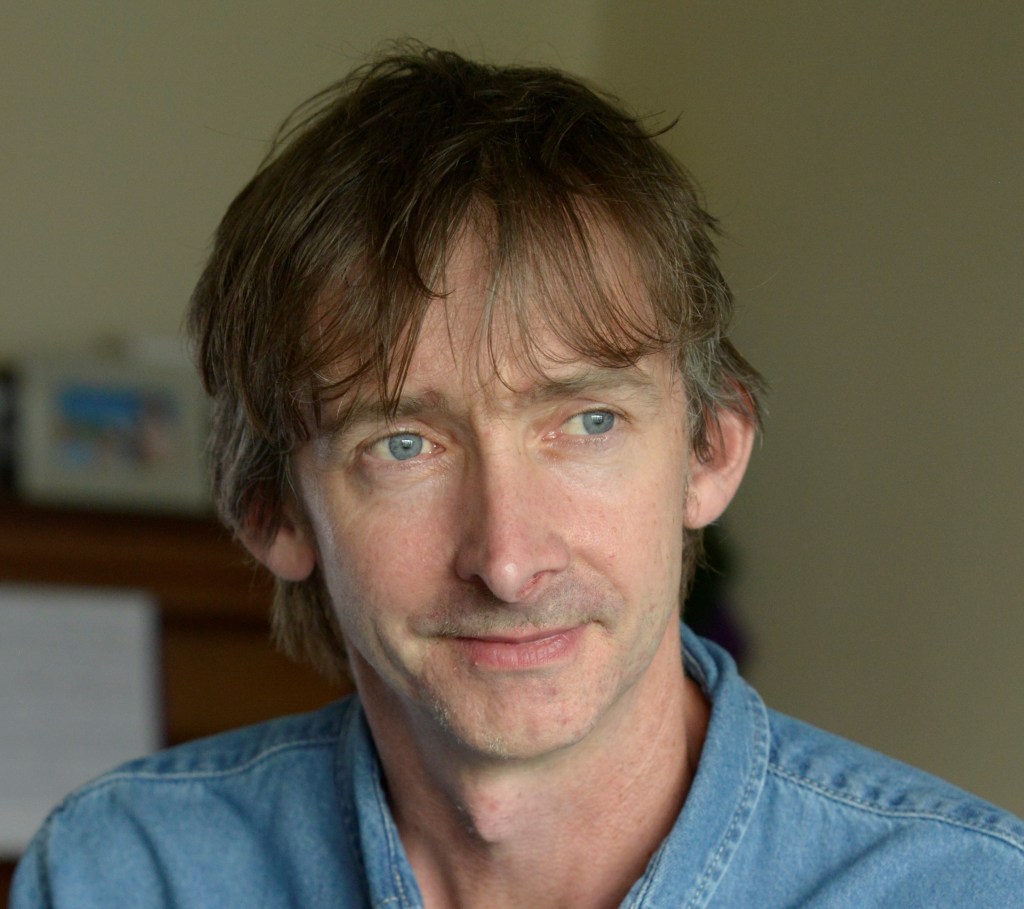
Photo courtesy of David Ruffles

John Hearne was born in Wexford, Ireland in 1970. He worked as an economist in Dublin before changing direction and becoming a freelance writer. He has ghostwritten and edited a range of bestselling books, while his journalism has appeared in numerous national and international newspapers and magazines.

His first middle grade novel, The Very Dangerous Sisters of Indigo McCloud was published to critical acclaim by Little Island in 2021. His second book Someone’s Been Messing with Reality is out now. You can find him on Instagram @johnhearneauthor.

www.johnhearneauthor.com

PaperBound Magazine is an online magazine for the young, and the young at heart. We are dedicated to showcasing authors and illustrators for children’s and young adult fiction and we strive to deliver inspiring content, uplifting stories, and top tips for young and aspiring writers yet to burst on to the literary scene.

All our issues are completely free and run by volunteers, however if you would like to support PaperBound and the work we do, you can help us out by buying us a virtual book. We appreciate any support you can give us!

Don’t forget you can read with the latest issues of PaperBound Magazine – completely free – here.

Blog, Blog series, Writing craft

Guest blog post: Patricia Forde on Returning to Speculative Fiction

PaperBound Magazine are thrilled to feature our first ever guest blog post in a series on the craft of writing from established authors.

Take a look to see award-winning author Patricia Forde’s take on writing speculative fiction.

Her new book The Girl Who Fell to Earth is out now.

Patricia Forde: Return to Speculative Fiction

I have always loved speculative fiction. I cut my teeth on Margaret Atwood’s fantastic books and swiftly moved on to writers like Philip Pullman and his amazing Northern Lights series.  

There are many definitions of speculative fiction as a genre, but I see it as all fiction that is not based in the real world. That includes science fiction, fantasy and tales of magic realism.  

In these types of books, writers speculate about other worlds. In my first novel, The Wordsmith, I was looking at a post-apocalyptic world. This was a future version of Earth, showing Ark – a world that was much kinder to the environment, producing energy in natural ways and leaving a very mild footprint on the planet.  

But Ark had its own problems. It was a harsh place for the human spirit. Music was banned, art was banned, and the language of Ark was List – a list of five hundred words. The people in power used the list to suppress free speech and to exercise total control over its people. 

Writing post-apocalyptic fiction is very similar in my head to writing historical fiction. In historical fiction you are writing about a world that was, building on some facts and imagining the rest, and with the other you are writing about a time that might happen in the future. Both demand a certain amount of inventiveness!  

When I was writing The Wordsmith duology, I took some advice from an article I read by Margaret Atwood. Amongst other things, she said that her speculative novels borrowed a lot from history. So, I turned to Irish history and was reminded of the time when the Irish language was being suppressed by the British.  

During Penal times tally sticks were introduced to suppress language.  A stick was hung around a child’s neck, and each time the child spoke Irish at school, a notch was put on the stick and the child received a slap for each notch at the end of the day.  

I took that idea and applied it to the citizens of Ark. Punishment using forbidden words involved the sinner being thrown into the woods to be eaten by wolves!  

In the second book of that duology Mother Tongue, I used the ancient Irish hedge schools as a model for the rebels in Ark to teach language. Some readers might have noticed that the rebels borrowed quite a bit from Michael Collins in their political structure – using small independent cells so that no one group held all the information! 

In my new novel The Girl Who Fell To Earth I returned to the realm of what-if and looked at what might happen if someone from a far more advanced Planet came to Earth.  

Terros is a planet run by scientists, where the environment is protected, and people live forever. Aria, the protagonist, has been brought up to despise humans who are well on the way to destroying their own planet.  When she is sent to Earth on a mission to destroy human life, she finds that, for all their faults, humans have some excellent qualities, and she sets about saving them and herself. 

In this book as in The Wordsmith I want children to get a glimpse of other possibilities, other ways of living, and other ways of co-existing with fellow creatures on their planet. I don’t believe in Utopias and these worlds that I create are far from perfect, but I think all of us, and maybe young people in particular, should be encouraged through literature to explore possibilities, and see that other models of living are possible.  

Some of those models are there to sound a warning; others to encourage a better way of living. 

For me, I don’t think I’ll ever stop wondering what-if and hopefully those musings will inspire me to write more speculative books!

Photo credited to Julien Behal

Patricia Forde

Patricia Forde lives in Galway, in the west of Ireland. She has published many books for children, in Irish and in English, as well as plays, soap operas and television drama series.
In another life, she was a primary school teacher and the artistic director of Galway Arts Festival. Two of her novels with Little Island, Bumpfizzle the Best on Planet Earth and The Wordsmith, a Library Association of America Notable Book for Children (published in the USA by SourceBooks as The List), were awarded White Raven awards by the International Youth Library.
Her picture book To the Island was co-published by Little Island and Galway 2020 European City of Culture. She is the seventh Laureate na nÓg, Ireland’s Children’s Literature Laureate. 

The Girl Who Fell to Earth is out now and published by Little Island.

PaperBound Magazine is an online magazine for the young, and the young at heart. We are dedicated to showcasing authors and illustrators for children’s and young adult fiction and we strive to deliver inspiring content, uplifting stories, and top tips for young and aspiring writers yet to burst on to the literary scene.

All our issues are completely free and run by volunteers, however if you would like to support PaperBound and the work we do, you can help us out by buying us a virtual book. We appreciate any support you can give us!

Don’t forget you can read with the latest issues of PaperBound Magazine – completely free – here.

Blog, Interview, Interviews

Interview: Julia Turk talks her Debut Trilogy, Writing Dystopian Novels, & Publishing Deals

PaperBound Magazine are thrilled to feature a blog Q&A with sci-fi and fantasy author Julia Turk.

This interview has been composed and written by freelance writer Cailey Tin.

Q&A with Julia Turk

What was the core idea that inspired your debut novel, Lone Player? And its name is also super cool, where did you get it from? ?

I found my inspiration for Lone Player when I was about twelve years old. I was scrolling through Pinterest and found a photo of a playing card tattoo that I really liked. It got me thinking – what if everyone had playing card tattoos? What would that society look like? I eventually tied in population control, and after that I developed the system of Running and Chasing.
While this is what inspired the world-building aspects for me, at its core, I suppose the main thing that inspired Lone Player was the concept of a Runner and a Chaser actually knowing each other. I was really interested in this relationship dynamic. I kept thinking, how can you unlearn that kind of hate? Or is there even hate there to begin with? I wondered what would drive a person to Run or Chase in the first place, even if they knew the consequences, which is how I eventually came up with the relationship between Ren and Eddie.
As far as the title goes, it actually took me quite a bit of time to find one that I felt suited the book best. I tested out a lot of different names, but I didn’t come up with Lone Player until I was scrolling through a list of playing card terms, and that one immediately caught my eye. The term refers to an independent card player, essentially, and I thought it really tied into the overall theme of the book. 

When did you know that you wanted to be an author? Did you write any books before Lone Player ?

I’ve been a writer for as long as I can remember. I’ve spent my whole life planning story ideas and starting books I never finished. Storytelling is just something I’ve always done and I’ve never not been writing something.
I’ve always wanted to publish a book. However, in terms of my career, I didn’t realize I wanted to be a professional author until quarantine. I grew up wanting to be a marine biologist so I could study cartilaginous fishes (sharks, rays, etc.), but after my chronic Lyme disease and co-infections took a turn for the worst in the middle of my sophomore year in high school (which was also the start of quarantine), I realized a physically-demanding job like that might not have been too realistic for me, especially after I had a couple of major leg surgeries. Plus, while I love science, I hate the math that comes with it.
So during this time, when I was about fifteen, I realized I wanted to be an author instead. Writing was the perfect solution. It was flexible enough to work around my illness and bad legs, and I just really felt drawn to it. Maybe I’ll do something else on the side someday to keep me busy— like working the front desk of some haunted Victorian-style inn or antique shop— but writing is at the centre of what I want to do.
I haven’t written any books before Lone Player. As I mentioned before, I grew up writing, but I never actually finished an entire project until this book. I don’t think I would have finished it if it weren’t for the Lost Island contest, which gave me the deadline and pressure I needed to get over my fears and simply write. I still can’t believe my very first (and very rough) manuscript won, but to me, it’s an important symbol of what might happen if you do things that scare you now and then.  

What would you say is your interesting writing quirk?

I’d say my most interesting writing quirk is the fact that I dream in stories. A lot of book ideas come to me in my sleep. Sometimes it’s literally like I’m watching a movie. There are characters played by actors, plots, movie trailers, a soundtrack, even a credits sequence at the end. It’s really bizarre. One of my most vivid ones even has its own folder in my Google Drive as a potential writing project.

What is the most difficult part of being a writer for you?

For me, the most difficult part of being a writer is the insecurity. Thanks to my anxiety and OCD, I struggle with a really bad imposter’s syndrome. I always feel like the things I’m writing make no sense, or that I’m upsetting people, or that I’m just not good. Another thing I worry about is that my story has already been written, or that it’s too simple.
There are so many worries a person can have as an author, especially if you’re a perfectionist like me. But by writing through the worries, I’ve learned a lot about how to handle my fears and perfectionism. The best thing you can do if you struggle with something similar is to write anyway, even if it’s scary. 

Since you’re also an avid reader, what books inspired aspects of your own projects? Do you read the same genres you write?  

Yes, I’m definitely an avid reader! Scythe, The Fifth Wave, and The Hunger Games were definitely huge inspirations for Lone Player, since I read those books in middle school (around the same time that I developed the idea for LP).
I usually read the same genres I write, mostly fantasy. But I’ve also been enjoying a few contemporary romances lately, which isn’t something I expected. 

On the topic of books, who are your favourite authors and what aspect of their writing do you admire the most?  

My favorite authors include Holly Black of course, Brandon Sanderson, and Margaret Rogerson, among many others. I love the characters and fairy folklore in Holly Black’s work, the world-building and intricate plots in Brandon Sanderson’s, and the really immersive, almost Ghibli-esque quality of Margaret Rogerson’s writing.

If you could tell your younger self anything writing related – whether it be publishing advice, drafting tips, anything, what would it be?

If I could tell my younger self anything writing-related, I think I’d tell myself to just write. I know you’re afraid. I know you’re scared of getting things wrong or not being good enough. But write anyway, because there is no such thing as bad writing. You can’t edit a blank page, and you can’t improve without actually getting the words out first. Always remember that writing is healing, and writing is growth—and it’s okay to do things that scare you every now and then. 

Julia Turk

Julia Rosemary Turk is an author and artist based in Northern California. She loves all things creative, and she spends her days downing matcha lattes and writing stories. Julia is the winner of the Lost Island writing contest and will have her debut novel, Lone Player, published by Lost Island Press this July 2023.

In addition to writing, Julia loves spending time with family, playing cosy games, and listening to indie rock. She’s been battling chronic Lyme disease since childhood and considers her illness a crucial part of her identity. 

Connect with Julia on her website, her own blog, and follow her on Instagram: @juliarosemaryturk.

Cailey Tin

Cailey Tin is an interview editor of Paper Crane Journal. She is an Asia-based staff writer and podcast co-host at The Incandescent Review, a columnist in Incognito Press and Spiritus Mundi Review, and her work has been published in Fairfield Scribes, Alien Magazine, Cathartic Lit, and more.
Her work is forthcoming in the Eunoia Review and Dragon Bone Publishing. Visit her Instagram @itscaileynotkylie.

Lone Player is out now and published by Lost Island Press.

PaperBound Magazine is an online magazine for the young, and the young at heart. We are dedicated to showcasing authors and illustrators for children’s and young adult fiction and we strive to deliver inspiring content, uplifting stories, and top tips for young and aspiring writers yet to burst on to the literary scene.

All our issues are completely free and run by volunteers, however if you would like to support PaperBound and the work we do, you can help us out by buying us a virtual book. We appreciate any support you can give us!

Don’t forget you can read with the latest issues of PaperBound Magazine – completely free – here.