Blog, Blog series, Bookshelf, Interview, Interviews, on writing, Writing craft

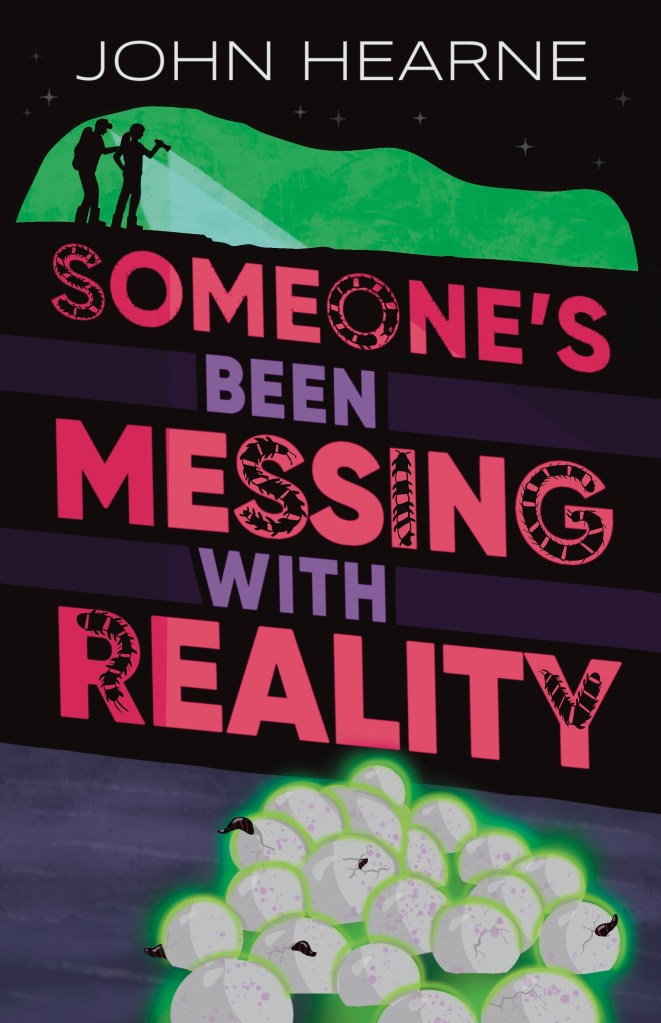
Interview: John Hearne chats about his speculative sci-fi novel ‘Someone’s Been Messing With Reality’ for middle grade readers

So here’s my tagline – ‘When Martin Ryan sees a video of his father flying unaided through the air, he realises that everything he has assumed about his life up to this point has been a lie’.

The whole novel arose out of the following proposition: ‘What if you were an alien, but didn’t know it?’ The moment Martin discovers the truth is also the moment that his parents disappear. He and his friends Tina and Enda realise that their disappearance is part of a larger conspiracy which they must unravel and thwart.

What inspired me to write it? I liked that proposition. Like a lot of writers, I log all the different story ideas that occur to me. Most of these ideas will never go anywhere, but if I hit one that’s sufficiently intriguing and exciting, I’ll start sketching out where I might go with it. What kind of characters could carry this kind of plotline? Where could I set it? Where will the intrigue come from? Once the ball gets rolling, it takes on a life of its own.

I’m a plotter and a planner. I like to work out where I’m going to go before I get there – but things always surprise you during the writing phase. I like to think of my outline as a map. I’m going to use it to get to where I’m going, but if I spot something interesting that doesn’t lie along the planned route, I’ll go explore it. The writing process tends to generate fresh ideas, and I think you’ve got to be open to evaluating them rather than sticking rigidly to the original plan.

Also, I often find as I write that that clever little plot detail or character quirk that I thought would work actually doesn’t, so I often stop midstream and rethink things. I find too that once you’ve established how a character acts, you’ve often got to give them more freedom that the original plot allowed. In Someone’s Been Messing with Reality, Martin’s friend Tina caused both him and me a lot of grief through her impulsivity – I had to keep readjusting things when I realised that ‘Hmmm, Tina would never do that…’

The process was similar, though it did have a lot more steps. I spent a lot of time figuring out exactly what would happen with Indigo before I dived into draft 1, but because this was my first attempt at anything like this, draft 1 was pretty much like the first chair that a trainee carpenter might make. The back was crooked and all the legs were different lengths. It went through several redrafts before I arrived at something that I would willingly show anyone – and the finished product didn’t bear much resemblance to the first draft. It’s true that most books aren’t written, they’re rewritten.

The Very Dangerous Sisters of Indigo McCloud had a fictitious setting – the absurdly miserable town of Blunt, and was choc-full of outlandish characters. I wanted to set Someone’s Been Messing with Reality in the real world, and make the characters a little more human. This is sci-fi – yes – but the relationships and problems and characters themselves are all real, or as real as I could make them.

Enda is one of the three friends at the centre of the book. He’s recovering from a brain injury. The emotional arc of the story rests on the different ways in which his two friends deal with this. I’ve always had an interest in brain injury. I made a radio documentary for RTE Radio 1 a few years ago about someone who was recovering from a very serious head injury. The weird thing is that after I had started work on this book, and after I had written Enda into it, I fell and hit my head. I gave myself what would be termed a ‘mild brain injury’. It may not have been life threatening, but it was very debilitating.

To cut a very long story short, I suffered from prolonged bouts of fatigue and could do very little work of any kind for a long time. Thankfully I’m fully recovered now, but the process took a couple of years. I couldn’t use a computer for much of that recovery. I had damaged the visual cortex at the back of the head, and my brain simply couldn’t deal with the kind of light that emanated from the screen. So much of this book was actually written longhand.

It has been lengthy! Much rejection, much rethinking, rewriting, repositioning. Getting published is hard and getting harder. This book – my second – was a little easier than the first, because I had a good relationship with the publisher, and they were happy to read what I wrote, but it had to reach a higher standard to get through. Rising costs have made it more difficult for independent publishers to take a chance on something, so they’ve got to love it before they’ll agree to put scarce resources on the line.

Since my book is science fiction, I’ll stick to that. My favourite in the genre is When You Reach Me by Rebecca Stead. A wonderful book, with a plot that rumbles slowly under the surface – you don’t quite realise that it’s sci-fi until close to the end. I also really like Ender’s Game by Orson Scott Card, the Dune books and The Iron Giant. My kids also love Hilo: The boy who crashed to earth by Judd Winick.

Much of the standard advice is correct. I think you need to do three things – read in the genre you’re writing in, develop your craft by reading about writing or taking classes, and finally, get feedback on your work. The third one is the one that most of us struggle with, but if you’re ambitious for your writing, you need to show it to people – and not just any people – I’m talking about people who understand the market and know what good writing looks like.

The other thing I’d say is that if your sole ambition is to get published, you are probably letting yourself in for a great deal of misery. Unless you’re exceptionally talented and blindingly lucky, the chances of getting published early in the game are low.

I write because I want to get published, yes, but I also write because I love to write. If you don’t love it for its own sake, I would chuck it in. You only get so much time on earth, so you’ve got to get something out of the journey. Without a love of the process, the time will feel wasted, and the destination – even if you do reach it – will not live up to expectations.

I’m working on something alright, but as we speak it’s an unholy mess. I’ll let you know if and when something readable emerges from it …

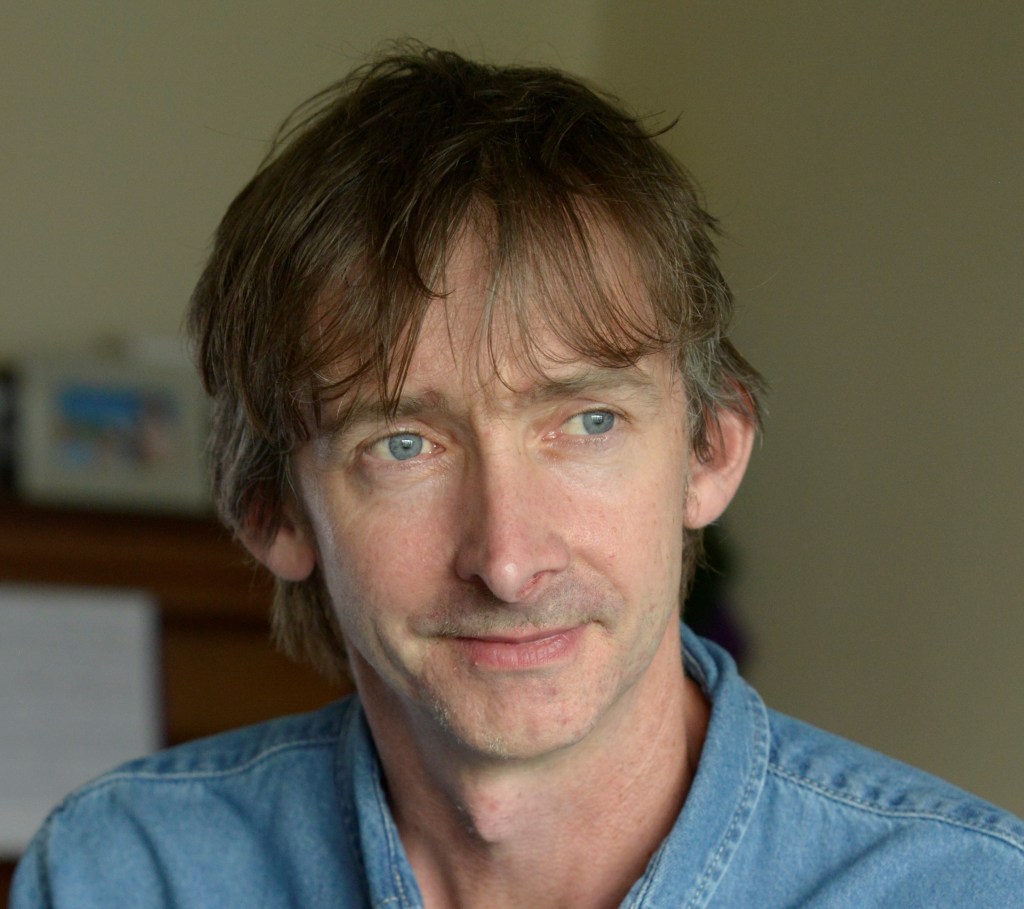
Photo courtesy of David Ruffles

John Hearne was born in Wexford, Ireland in 1970. He worked as an economist in Dublin before changing direction and becoming a freelance writer. He has ghostwritten and edited a range of bestselling books, while his journalism has appeared in numerous national and international newspapers and magazines.

His first middle grade novel, The Very Dangerous Sisters of Indigo McCloud was published to critical acclaim by Little Island in 2021. His second book Someone’s Been Messing with Reality is out now. You can find him on Instagram @johnhearneauthor.

www.johnhearneauthor.com

PaperBound Magazine is an online magazine for the young, and the young at heart. We are dedicated to showcasing authors and illustrators for children’s and young adult fiction and we strive to deliver inspiring content, uplifting stories, and top tips for young and aspiring writers yet to burst on to the literary scene.

All our issues are completely free and run by volunteers, however if you would like to support PaperBound and the work we do, you can help us out by buying us a virtual book. We appreciate any support you can give us!

Don’t forget you can read with the latest issues of PaperBound Magazine – completely free – here.

Blog, Interview, Interviews

Interview: Meg Grehan in conversation with Siobhán Parkinson

To celebrate today’s release of middle grade title The Lonely Book, we are excited to share an interview of author Meg Grehan in conversation with Siobhán Parkinson. This is a loving story about gender identity, family, and the magic of books.

Annie’s family is made of love.

When her moms open up their bookshop in the mornings, there is always a mysterious pile of books on the counter. By evening, every book has found its ideal reader. But one day there is a book on gender identity that doesn’t get bought. Who can its reader be, and why don’t they come?

 Days pass, and the book with no owner gets lonelier and lonelier. The bookshop is unhappy, its magic starts to go awry, and the moms are worried that the shop isn’t making enough money. Meanwhile, Annie’s sibling has become withdrawn.

Annie has a plan to save the shop, but is this all that’s worrying her sibling?

Meg, I was thinking about what a lovely – and intriguing – title ‘The Lonely Book’ is. And of course this new verse novel is not just about a book — it’s actually set in a bookshop. Which reminds me that the main character in your first book, The Space Between, worked in a bookshop. So it seems that you are drawn to the idea of bookshops, not just as places to visit as a customer, but as rather enchanting places to work in. Have you ever worked in a bookshop, or is it just a dream?

I love bookshops. When I found it harder to leave my house they were real sanctuaries to me, little homes away from my real home. If I could get home I was OK, and if I could get to a bookshop I was OK. I think bookshops are so special, so unlike anywhere else.

I did work in a bookshop! I was a bookseller and I did most of the ordering. It was very fun but a lot more stressful than I expected! I loved getting to talk to people about books, help them with their most specific and niche requests. I need a book about a sloth, I need a book about the high seas, I need a book about … I loved that! Getting to know people has always been easiest for me when it’s through books. I feel confident that I know and understand the world of books and it’s where I feel safest, so working in a bookshop was very special to me.

And of course in this story, the bookshop has a very special kind of magic. It is the bookshop itself that chooses certain books and makes sure that they find their ideal readers. Later in the story, when this one unattached book, the lonely book, doesn’t find its person for some time, the bookshop gets very agitated. How did you come up with such an extraordinary device?

When I worked in the bookshop I had a little desk down the back where I would unbox all the new books I’d ordered, put them on the system and get them ready for the shelves. There were a couple of instances when someone would come up and say, ‘Oh, I heard about this book, it’s about …’ and I would have that very book sitting right in front of me! They always reacted like it was magic, and I always kind of felt like it was. That’s what gave me the idea for a bookshop that works with its people, helps with some of the bookselling – though they still have to find the right readers, of course.

The idea of a magic bookshop works very well in a story that centres on such a young character. I mean Annie, who is about eight or nine? She is not exactly the main character (that is probably Annie’s older sibling, Charlie); but Annie is a main character in another sense, because the story is told from her point of view. That was an interesting decision. It is Charlie’s story, but it is told from Annie’s perspective. What made you think of telling it that way?

I agree that Charlie is really the main character, but for what I wanted to achieve with this book Annie made sense as the character whose point of view we follow. In my last book for children, The Deepest Breath, we followed Stevie as she discovered that she liked girls. It made sense to follow Stevie on that journey, as she was starting from the complete beginning. It’s the same with Annie: she doesn’t know anything about gender at the start of the story and it makes her the perfect character to learn and grow with.

Charlie is a little older, a teenager, and a book about them would be a YA (young adult) story. But I felt that this book needed to be middle-grade – for younger readers. Just like with The Deepest Breath, I wanted to introduce concepts gently and carefully and in a positive way, and following Annie allowed me to do that. It is also very much Charlie’s story, though, I love them so much and I do think we see a lot that goes on with them through Annie’s eyes.

Yes, I see what you mean. The central issue, which clarifies as the story opens up, is that Charlie is starting to realise that they are non-binary. That is a big idea to mediate through the thoughts and worries of a much younger child, but it works really well, doesn’t it? I suppose Annie’s openness to new ideas is something that comes naturally to her, as a child – when you are small, everything is new, and you maybe haven’t acquired too many prejudices. So that makes her an ideal narrator, would you agree?

I do agree! It’s what’s so amazing about children, isn’t it? They learn and learn and learn every day, they are so open and ready for new things and so, so brave.

I wrote The Deepest Breath and The Lonely Book for younger readers because they both deal with topics I don’t think are written about enough for children. Queer stories are for everyone, and I wanted to share some!

Annie might be very young and very open, but she does also suffer from anxiety. Her worries are a kind of subplot – she knows there is something bothering Charlotte; she knows her mothers are worried about something completely different – whether the bookshop is financially secure. And one reaction she has to these anxieties is that she finds very often she can’t speak. Can you tell us a bit about selective mutism and why you chose to explore it in this story?

Selective mutism is a type of anxiety disorder that means that sometimes you just can’t speak. I decided to write about it because I have it. In times of extreme stress I lose the ability to speak. For instance, during the height of the pandemic I couldn’t speak at all for almost a year. My speech slowly came back but it was quite scary. Generally it just manifests in little ways: like, in an argument, sometimes words just vanish for me. It feels like quite a betrayal because I have always considered words friends. Writing about it, however minor a subplot it may be, was really nice for me. It reminded me that words take many forms and I am never truly without them.

Using sign language to overcome mutism is a creative as well as a very loving response, and the whole family becomes involved. Can you tell us a bit about that?

Again, that comes from personal experience. For those months when I couldn’t speak my girlfriend and I learned sign language. We learned together and it was a very beautiful thing. It was her idea. We had tried a text-to-speech app but I didn’t like that, and we tried me writing things out, but it was such a slow process. Sign was the perfect answer. We loved learning it, we loved using it and I loved it so much that she learned it with me; and that made me feel so loved and respected and valued. And so that is why I wrote that into the story of The Lonely Book. It just seemed right.

The love that Annie and Charlie share with their two mothers is very strong, very warm, very sustaining. And emotionally very satisfying to read about. It is the core of the book, really. But I like how you don’t allow the fact that this family is united in love and togetherness to be an easy solution to their various anxieties. It’s important that they have each other, but it’s not enough to make all their worries disappear. Can you tell us a bit more about your thinking on this?

I am very lucky to be in a relationship for almost twelve years now with a warm, funny, kind and caring person. I am loved and cared for and supported beyond what I ever thought possible. But I still have my anxieties, my troubles, my worries and struggles. The love I receive and the love I give can soothe these worries, they can lessen the load, they can calm me when things get too much. But they cannot take them away.

It isn’t fair to expect a person, no matter who they are, to fix your problems or take away your struggles with just the power of love and togetherness. But it is OK to expect respect and love and tenderness, I think. That’s what this family do: they love and respect and care for each other because they are a family and this is what comes naturally to them. They don’t expect each other to fix everything for them, or expect themselves to be able to fix everything for the others.

This is what Annie is learning, you can’t fix everything for a person, even if you wish you could. But you can love them and support them and be there for them, and that can be just as powerful.

The Deepest Breath, which is also written for quite a young readership, is realistic, as was your first book, The Space Between, which is more for a YA audience. Then, with Baby Teeth, definitely YA, you plunged right into fantasy (almost horror), and that went down very well!

Do you think Baby Teeth opened up the way for the kind of magic realism we find in The Lonely Book? Maybe in the same way that centring the story on a younger child in The Deepest Breath might have inspired you to write The Lonely Book also for a young audience?

Maybe! I’ve never had any interest in categorising myself when it comes to writing. I am not a person who has a lot of ideas, I am not at all brimming with them and I rarely have to choose between them to decide what to write. Usually I have one idea and I sit with it for as long as it takes to form and grow and develop. Then I write it.

Same for me!

Beth (the main character in The Space Between) came to me first, then Stevie (The Deepest Breath), then Immy (Baby Teeth) and now Annie. Immy was the most self-indulgent for me (though it may seem to be Beth from The Space Between!) because I love horror, I love paranormal stories, I love the innate drama of vampires and the idea of many lives lived.

I also love not holding back when I write, letting myself be as over-the-top or dramatic or even maybe pretentious as I want to be and Immy let me do that. I very much wrote that book for myself and the fact that other people liked it too definitely made me much braver moving forward, which, yes, could have played a part in inspiring me to write about a magic bookshop.

All your books, Meg, are verse novels. Do you find that verse comes to you more naturally than prose? And do you find that audiences respond especially well to the poetic form?

It definitely comes more naturally to me. I have always, always loved poetry. My nana wrote poetry and she wrote a poem about me when I was little. I still have the book that it’s published in on my bookcase. I like to think she wrote me into the world of poetry.

What a gift!

Wasn’t it just?

I was also a drama kid. I performed poetry I loved and wrote and performed my own poetry. I’ve always read it, always written it, and always loved it. So when I learned that books could be poetry too, that I could write a whole story in a poetic form, a new world opened up to me. It just comes naturally to me, it makes me happy, it makes me feel free and brave and inspired.

I love verse a lot, and I do think people respond well to it, even if they don’t quite know what it is. I try quite hard to make my verse accessible and make it flow nicely so it isn’t too taxing to read and I think, or I hope rather, that readers feel that. I think people are often surprised by how much they like verse, it kind of delights me!

Yes, I see what you mean about how naturally it comes to you, but I’m still wondering if it was a conscious decision to use verse as a form and magic realism as a storytelling style in order to tackle a subject that some readers might find more difficult to think about if they encountered them in a realistic novel or one in prose?

Honestly, no, not really. I trust readers, I trust young readers. I think they can handle bigger ideas and concepts than we give them credit for.

I totally agree, Meg. I think that respect for young readers is what marks the best writers for children and young people.

So, the reason I chose verse is that that is what I love and how I write best, and I wanted to give this story it’s best chance at being good. And I chose magical realism or fabulism because it allowed me to tell the story I wanted to tell and because the idea excited me. I think it just worked out well that these choices helped me in telling the story as clearly and accessibly as I could.

And it all worked out pretty well perfectly! Thank you, Meg, for talking to me, and thank you for this wonderful book.

You can catch this interview in the back of The Lonely Book upon its paperback release from Little Island Books. We want to thank Little Island for giving us permission to publish this interview on our blog to celebrate this fantastic release!

PaperBound Magazine is an online magazine for the young, and the young at heart. We are dedicated to showcasing authors and illustrators for children’s and young adult fiction and we strive to deliver inspiring content, uplifting stories, and top tips for young and aspiring writers yet to burst on to the literary scene.

All our issues are completely free and run by volunteers, however if you would like to support PaperBound and the work we do, you can help us out by buying us a virtual book. We appreciate any support you can give us!

Don’t forget you can catch up with the latest issues of PaperBound Magazine here.