Blog, Blog series, Interview, Interviews, Writing craft

Interview: YA author Shelby Mahurin chats about ‘The Scarlet Veil’

Of course! The Scarlet Veil is the first in a new duology set in the same universe as Serpent & Dove. It follows Célie Tremblay, the first woman initiated into the brotherhood of Chasseurs, as she investigates a string of murders in Cesarine—all the victims of magical origin, all their bodies drained of blood. Her investigation leads her straight to the heart of a vampire lair, where she captures the attention of its cruel yet beautiful king. He has plans of his own for Célie, who refuses to acknowledge the whispers from her past that still haunt her.

Interestingly enough, no—I didn’t plan to tell Célie’s story at all. In the thick of deadline with Gods & Monsters, I even swore I’d never return to the world of Serpent & Dove again. I wanted to tell new stories with new characters; I’d even sold another duology about Greek sirens! With a little time and distance, however, I realized I wasn’t quite ready to let the world go. When I called my critique partner on the way home from my local indie the day before Gods & Monsters published, crying, she told me it didn’t necessarily need to be over—and then she asked about Célie. We both agreed her story hadn’t reached its conclusion, and I’d always wanted to write a vampire book. Their inclusion felt like a natural extension to this world. Within ten minutes, we’d plotted out a rough outline of The Scarlet Veil, and the rest is history.

Yes! I always knew The Scarlet Veil would end the way it did, and I knew I didn’t want to write another trilogy so soon after Serpent & Dove. Thus, a duology was the perfect fit!

It seems like the trickiest part for me to write is always the part I’m currently writing. Ha! In all seriousness, though, Célie is an extremely emotional and vulnerable character—a complete foil to Lou and Reid, who both avoid their emotions at all costs. I personally err more on their side of emotional avoidance, so it took a lot for me to sit with Célie and her feelings. Other scenes that are always difficult to write are action sequences; I know literally nothing about self-defence, so whenever Célie or Michal needed to physically fight someone, it meant a lot of time on the internet looking up choreography and trying to describe such technical movements in a natural way.

The easiest scenes for me to write involve romance—banter, sexual tension, a lingering look. Those are always my favorite.

I’ve always loved vampires—Twilight, The Vampire Diaries, Underworld, and True Blood were pillars of my adolescence. There’s something inherently seductive about a vampire, especially after Bram Stoker brought a refined façade to their savagery with Dracula. Maybe it’s because vampires are so powerful with their predatory speed and strength, or maybe it’s because they’re immortal. They never grow old. They live forever young, forever attractive, yet they’ve seen things we haven’t. They know things we don’t. It’s the ultimate fantasy, isn’t it? For such an all-powerful creature to fall in love with a human? And then there’s the whole business of their drinking our blood—it makes everything all the more dangerous, and don’t we all crave a little danger? I know Célie does.

It’s so interesting that you mention worldbuilding specifically because—to be completely transparent—I’ve never loved worldbuilding. Or at least, I’ve always loved it less than character work and romance. In fact, I would argue that most of the worldbuilding in The Scarlet Veil came along as a means to cram every single trope I love into this story. The vampires’ casket company, for example, was an answer to the question, “How can I realistically get Michal and Célie into one casket together?” It needed to make sense. It needed to feel like a natural progression of both the plot and world. And so, I started brainstorming, and one thing led to another, and of course vampires have always needed a way to sneak into Cesarine, right? Lou and Reid would’ve known about them in the original trilogy otherwise. And Célie needed to face her fear of caskets after what happened with Filippa in Blood & Honey. And thus, Requiem, Ltd. was born. I could think of a dozen more examples of this sort of jigsaw puzzle worldbuilding, but you get the idea.

My advice to aspiring authors would be to lean into what you love—find a way to use it, to leverage it throughout your story, and the pieces will fall into place.

Good romance requires tension. Lots of tension. For me, that means I need both an internal and external reason to keep the lovers apart. Otherwise, why wouldn’t they get together as soon as they feel that first spark of attraction? Again, those reasons also need to make logical sense; nothing infuriates me more as a reader than a flimsy excuse for two people who want to be together not being together. The reasons also need to involve personal stakes—what will happen if they do get together? It needs to have a real consequence.

I’m still drafting The Scarlet Veil’s sequel now, but afterward, I’ll be returning my attention to the Greek siren duology I mentioned earlier. I actually sold those books back in 2020 and 2021, so I’m extremely eager to get back to them!

Shelby Mahurin is theNew York Times bestselling author of the Serpent & Dove trilogy. She grew up on a small farm in rural Indiana, where sticks became wants and cows became dragons. Her rampant imagination didn’t fade with age, so she continues to play make-believe every day—with words now instead of cows. When not writing, Shelby watches The Office and reads voraciously. She still lives near that childhood farm with her very tall husband and semi feral children.

PaperBound Magazine is an online magazine for the young, and the young at heart. We are dedicated to showcasing authors and illustrators for children’s and young adult fiction and we strive to deliver inspiring content, uplifting stories, and top tips for young and aspiring writers yet to burst on to the literary scene.

All our issues are completely free and run by volunteers, however if you would like to support PaperBound and the work we do, you can help us out by buying us a virtual book. We appreciate any support you can give us!

Don’t forget you can read with the latest issues of PaperBound Magazine – completely free – here.

Blog, Blog series, Interview, Interviews, Writing craft

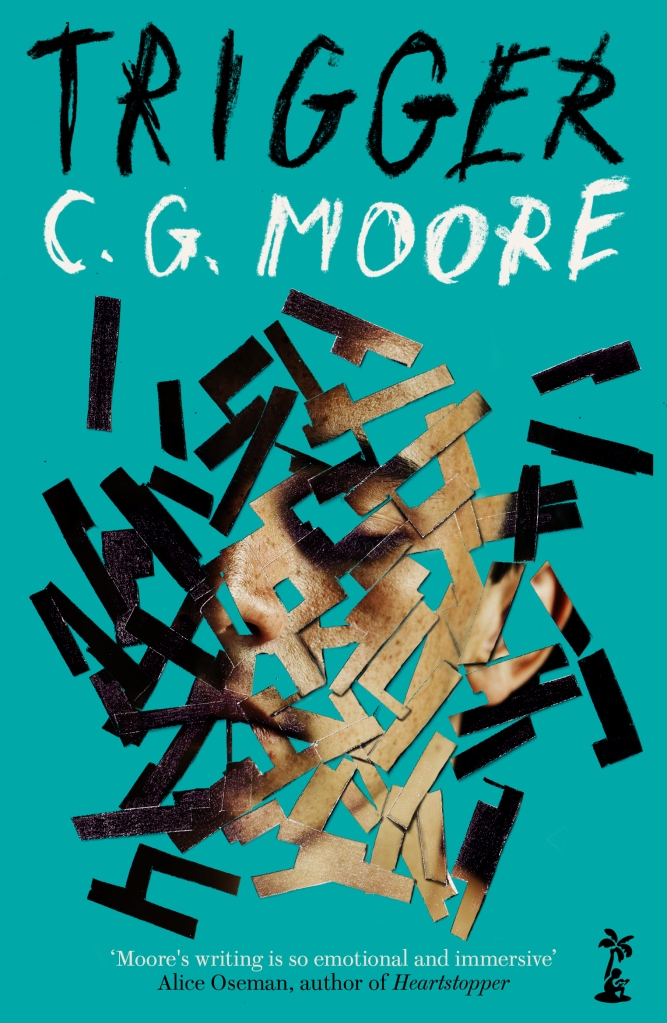
Interview: Michael Thomas Ford chats about his new novel ‘Every Star That Falls’

Every Star That Falls begins the day after Suicide Notes ends. Jeff returns home and goes back to his old life, but he’s no longer the old Jeff. He has to figure out what that means in terms of his relationships with his family, his friends, and his larger community. He also wants to explore what it means being an out member of the LGBTQ community, which involves finding a support group. The people he meets there change his life even more, in ways he could never have imagined a couple of months ago. 

It’s definitely surprising to me how Suicide Notes continues to find new readers. It’s also a testament to the power of social media, which wasn’t really a thing when the book first came out. Now, readers are sharing their experiences of the book on places like TikTok and Instagram, and that’s allowing it to connect with even more readers. One of the things I love most about the world right now is that the voices of readers are so strong and so powerful. They’re not waiting for anyone to tell them what to read and what they should like, they’re deciding for themselves and then spreading the word. It’s fantastic to watch this happen.

The most powerful tool for creating change is empathy. When we learn to really listen to people – particularly to people with whom we might not think we have anything in common – and hear about their experiences and what they feel, we learn to see the world in a different way. That’s how change happens. When we create barriers between us, we only see things from one perspective and it’s easier for other points of view to feel threatening. There’s much more that connects us than divides us, and learning to focus on those things while allowing for differing perspectives is what creates forward movement.

Jeff is essentially me, and I have always approached difficult situations by looking for the humour in them. I think that if you can find a way to laugh, even in the darkest moments, it creates a spark of light that grows brighter and shows you the way through. I realize not everyone appreciates this approach, because we’re all different, but for me the most effective way to deal with life when it gets hard or seems hopeless is to find the moments of joy that remind me that the darker times don’t last forever. 

In general, I don’t enjoy sequels because no matter what happens, someone is disappointed. Once someone falls in love with a character, they developed expectations of what they want for them. With Suicide Notes I wanted readers to imagine what happens to Jeff when he leaves the hospital he’s in for the whole book. But as time went on, I thought of more things I wanted to say about certain topics, and continuing Jeff’s story was the best way to do that. Also, there were some characters and events from Suicide Notes that I found readers asking about over and over again, and writing a sequel gave me the opportunity to answer those questions. 

I write for a number of different audiences, including adults and younger readers, so there’s always something happening. I’m currently finishing up a ghost-themed novel for middle grade readers, which is a lot of creepy fun. That will be out next year. And there just might be another part to the story about Jeff and his new friends coming. Readers can always find the latest news on my website: www.michaelthomasford.com.

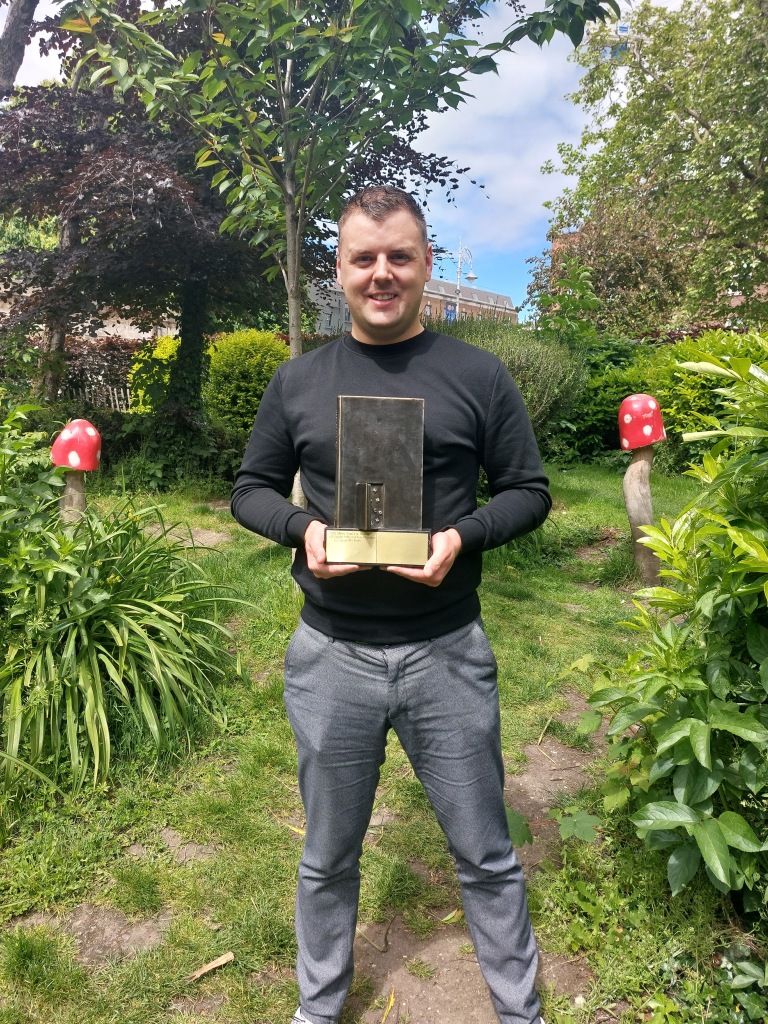
Michael Thomas Ford is the author of numerous works for both adults and young readers, including Suicide Notes as well as some of the earliest books about the HIV/AIDS crisis and several books about the LGBTQ community. A five-time winner of the Lambda Literary Award, he has also been a finalist for the Shirley Jackson Award, the Bram Stoker Award, the Firecracker Alternative Book Award, and the Ignyte Award. He lives in rural Appalachia with his husband and dogs.

PaperBound Magazine is an online magazine for the young, and the young at heart. We are dedicated to showcasing authors and illustrators for children’s and young adult fiction and we strive to deliver inspiring content, uplifting stories, and top tips for young and aspiring writers yet to burst on to the literary scene.

All our issues are completely free and run by volunteers, however if you would like to support PaperBound and the work we do, you can help us out by buying us a virtual book. We appreciate any support you can give us!

Don’t forget you can read with the latest issues of PaperBound Magazine – completely free – here.

Blog, Interview, Interviews

Interview with YA author Maya MacGregor

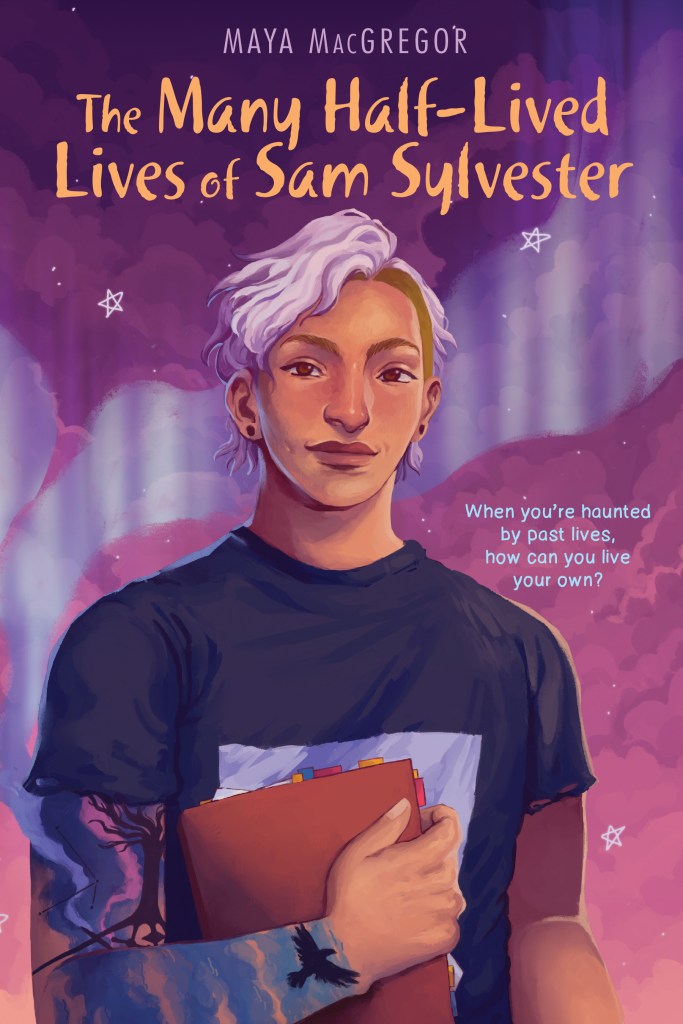
We were thrilled to chat with YA author Maya MacGregor about their new novel The Many Half-Lived Lives of Sam Sylvester. Read the interview below, or in the latest issue of PaperBound here.

Can you tell us a little about your YA novel The Many Half-Lived Lives of Sam Sylvester? What a title! 

The title was actually the first thing that came to me in this novel—originally, Sam had literal past lives, all of whom died before nineteen. That was the impetus for the title, and that’s where the story and characters germinated. Sam’s “half-lived lives” morphed through the submission and editorial process to become their autistic special interest, stories Sam felt compelled to keep alive. 

Writing Sam was very personal in a lot of ways. It’s a book about a non-binary, autistic teen who has grown up in rural Montana with their single dad, and after a near-fatal queerphobic attack, they move to Astoria, Oregon to start fresh … and right into a home where one of the half-lived lives ended. 

With the help of their new friends and love interest, Sam sets out to find out what really happened to this boy, bringing them up against a real-life murderer who has been hiding in plain sight for thirty years. 

How much of your own experience did you draw from, as someone who is non-binary and autistic yourself, when creating Sam as a character? 

A lot! A lot of Sam’s experiences in rural Montana are drawn from my own (I lived there from 1996-2003), and that was heavily influenced by the fact that I’ve two mums, and things were very hostile towards LGBTQ people. I myself was deeply in the closet until I was almost thirty. 

I self-diagnosed with autism when I was in my late twenties and got my formal diagnosis at 36. A lot of writing Sam’s story was influenced by my own self-discovery and understanding the parts of myself that had made me different. I wanted to give Sam that self-knowledge earlier than I had it myself, almost as a way of giving a gift to my inner child. 

I think when it comes to my non-binary identity, as an agender person who dislikes a lot of the language around gender (I don’t feel as though I “present” femme—to me, I’m a person wearing people clothes), it can be hard for me sometimes to assert myself. People tend to make assumptions because I don’t bind my breasts, because I love makeup and glitter and dresses. So writing Sam required me to unpack a lot of the internal pressure I feel to be androgynous if I want to be “taken seriously” as a non-binary person. 

I still find that difficult. I have a very complex relationship with the word “woman” as it applies to myself, and I don’t think I was fully ready to write a character who was like me. Sam felt safer in that respect—they’re genderqueer, and their personal style does lend itself more to androgyny than mine. 

There are also a lot of interesting ways that gender and autism interact—autistics have coined the term “gendermeh” or “gendervague” to describe the fundamentally autistic experience of operating outwith [nb: Scottish usage, not a spelling error, heh] expectations for gender and feelings about the same. It took me another couple books to really lean into writing a character closer to my identity, but Sam was very important to me in getting to actively explore non-binary characters explicitly. 

How important do you consider representation within YA novels, not only when it comes to readers but also to yourself? 

Vital. Absolutely vital. Just a couple weeks ago, I was in Aberdeen at Hazlehead Academy, speaking to 70-80 pupils from LGBTQIA+ equality alliances across the city, and it was really emotional to me. When I walked into the school and saw Pride murals, Pride flags, and more, that struck me so hard. 

I couldn’t have fathomed such a thing when I was that age. And the kids were so eager to speak with me, to ask me everything from how to cope with lack of motivation for writing … to how to come out to their parents. It felt acutely important for Sam to exist for them and for my own visibility in that moment to reflect back at them what I wish I’d had beyond my own family (and the way we were consistently shown that people found our mere existence dirty and shameful). 

I think I would have understood myself so much better if I’d had books like Sam, like Heartstopper, like The Gilded Ones and Felix Ever After and I Kissed Shara Wheeler and so many others. The day Sam came out, there were eight other queer YA novels published. The same day. Absolutely unthinkable even a few years ago. 

If we look at the power stories have to cultivate empathy for others as well as confidence in ourselves, representation is simply integral. Humanity is a vast and vibrant tapestry—and there’s room for everyone in this world. 

What do you do when you’re not writing? 

I’m a full-time editor and a full-time author, and I am also a Gaelic singer and songwriter, so I keep very busy! I like to play video games when I have some downtime, and I of course love to read, though because I spend so much time staring at screens and pages, sometimes I just need to turn off my brain and give my poor eyeballs a break! 

There’s nothing I love more than escaping into the Highlands, alone or with friends, to enjoy this beautiful land we call home. Last week, I was up in Argyll with my friend Hamish, spending the day hillwalking (25 kilometres, ooft!) and speaking Gaelic. 

What books do you consider your favourites? 

This is such a difficult question! I adore The Shadow of the Wind by the late Carlos Ruiz Zafón. It’s a Gothic novel set in Catalonia after the Spanish Civil War, and it isn’t fantasy, but it feels like fantasy. Barcelona is a character in and of itself. 

Another all-time favourite is A Wrinkle in Time by Madeleine L’Engle, which is I think where I realised how important representation was for the first time. Meg reads very autistic to me in her behaviours (she has set ways of doing things, often gets in trouble for being inflexible about it, is very literal), and I related to her so much as a kid. 

In more recent favourites, I absolutely loved Caitlin Starling’s The Death of Jane Lawrence, which is a fantastic gothic fantasy with an autistic protagonist. Deliciously creepy and beautifully written. 

Can you tell us what might come next for your writing, and if more YA novels might be on the horizon?  

I’ve got so many projects working that sometimes I feel like I’m steering a chariot drawn by a hundred horses at once! In most recent YA news, Astra Books for Young Readers also picked up my option book, The Evolving Truth of Ever-Stronger Will this year, which is in a similar vein to Sam Sylvester (non-binary autistic protagonist, some spooky paranormal stuff, resolving trauma and finding family). I’m so excited about this one. I’m actually working on edits for that right now, and you can expect some news about it in the next few months! 

Last year, I wrote a YA fantasy called Eatorra, which features (surprise!) an autistic agender protagonist who accidentally stumbles upon the Fair Folk in the west of Scotland and becomes one of them. It’s deeply rooted in Gaelic tradition and lore as well as intergenerational language transmission and coming of age. We’ve not found a home for it yet, but as we say in Gaelic, I remain beò an dòchas! (Alive in hope!) 

Beyond that, I’ve got a lot of other projects happening. As Emmie Mears, I’m closing out an epic fantasy trilogy in July 2023 (the Stonebreaker series) with Windtaker, and that series has solid crossover potential for YA readers as well, since the characters start out in their late teens. I’m also working on something under NDA as we speak that will be made public later this month (!), and I also write under a secret pen name, so I’m releasing something entirely different in another genre next month. I keep very busy! 

Oh, and I’m also working on my first Gaelic novel, called Sùgan Sàile, which is based on one of my favourite Gaelic waulking songs, “Thig am Bàta”. 

Maya MacGregor is an author, singer, and artist based in Glasgow, Scotland. A fluent Gaelic speaker, Maya is active in many community activities in Gaelic music as well as writing contemporary YA and adult fiction (as Emmie Mears and M. Evan MacGriogair). Maya has a degree in history and is passionate about writing the stories for teens they wish had existed when they were younger and fills them with the type of people who have always populated their world. Their pronouns are they/them. 

The Many Half-Lived Lives of Sam Sylvester is Maya’s first YA novel, and out now. It will be followed by The Evolving Truth of Ever-Stronger Will

You can find Maya online at www.mayamacgregor.com, and you can also find their work at www.emmiemears.com. On social media, they like to keep things simple: you can find them on Instagram, Twitter, and TikTok as @Maigheach. (The Gaelic word for hare!) 

Don’t forget you can catch up with the latest issues of PaperBound Magazine here. All our issues are completely free and run by volunteers, however if you would like to support PaperBound and help keep us running you can buy us a virtual book.

Blog, Interviews

Interview with YA author Julia Tuffs

PaperBound caught up with YA author Julia Tuffs to chat all about her debut novel, HEXED! Join us as we discover more about Julia’s writing, her top current reads, and how she came up with the idea for HEXED.

You can catch the full interview and all other issues of PaperBound FREE here.

Can you tell us a little about your novel, Hexed

Hexed is about Jessie Jones; new girl, witch and accidental activist. Jessie’s life is turned upside down when her mum suddenly moves the family back to her home town on the Isle of Wight. All Jessie wants to do is fade into the background, coast and avoid the attention of school douchebag Callum Henderson and his toxic cronies, but when strange and uncontrollable magical powers start to manifest during her period, flying under the radar becomes impossible. Hexed is about finding your place and your power and learning to love your differences. 

Your novel deals with important and timely themes, such as sexism and toxic masculinity, and easily puts the reader in Jessie’s shoes. What inspired you to write about these issues? 

Donald Trump – amongst other things! It was really painful to watch as someone who had boasted about grabbing women’s genitals was elected president and it was a moment in time that highlighted how little society values women and women’s rights. I wanted to write something that looked at how ingrained it is in all aspects of society – our schools, our media, our courts, our government – but I wanted it to be relatable and focus on what all girls experience and are forced to navigate through on a day to day basis. 

These themes are woven into a story about witchcraft. Can you tell us how you came up with the idea to combine these two things? 

I was thinking about the recent surge in our reproductive rights being threatened and all the ways men in power try to control women and women’s bodies (Britney, how can we help?!) and that led me to the witch trials; the way women were strip searched for Devil’s marks and how anyone single or widowed could be suspected and tried. Even today, like hundreds of years ago, if women don’t fit into a prescribed box – if we dare to be angry or outspoken or stray out of our lane – we’re labelled and shamed. I found the parallel interesting (and terrifying) and I loved the idea of that which makes us different actually making us stronger – which is how the period witch idea came about – wearing a super plus but being able to magic up your dinner and punish nasty boys! 

The setting of Hexed is vividly portrayed. Did you always plan on setting it on the Isle of Wight? What was it about this setting that you were drawn to? 

I love the Isle of Wight! My husband is from the Island and we lived there for a few years when our children were small. It’s such a unique setting – beautiful in places, 1950s seaside in other places, removed from the mainland and with a population that doubles over the summer. I wanted to explore how someone would feel moving there from a big city, especially if that person was trying so desperately hard to be invisible – which is basically impossible in a small town setting where everyone knows everyone and it’s harder to escape! I also loved the idea of being on Jessie’s journey with her as she falls in love with the Island and begins to appreciate how special it is.   

Can you sum up your novel in 3 words? 

Funny, feisty, feminist. 

What’s the one thing you’d wished you’d known before becoming a writer? 

That it’s a rollercoaster of emotions and A LOT of waiting – waiting for edits, waiting for news, waiting until you’re allowed to announce news, waiting for publication day… 

What are your top reads from the last year (MG or YA), and why? 

Oooh, this is hard – there have been so many good books! For YA, I’d say The Yearbook by Holly Bourne which is in her typical style of being frank and funny whilst also dealing with serious issues and Afterlove by Tanya Byrne which is a gorgeous and heartbreaking love story.  

After a brief (but fun) stint working in television and as a primary school teacher, Julia decided to take her writing dreams more seriously. She lives in South-West London with her family and ragdoll cats (Billy and Nora) and spends her time writing, reading, dreaming of holidays and watching too much reality TV. She aims to write the kinds of books that shaped and inspired her as a teenager. HEXED is her debut novelYou can keep up to date with Julia on Twitter, Instagram and by visiting her website.

HEXED was released in July 2021 by Hachette. It is available NOW in the UK and Australia. 

Don’t forget you can catch up with the latest issues of PaperBound Magazine here. All our issues are completely free and run by volunteers, however if you would like to support PaperBound and the work we do, you can help us out by buying us a virtual book.