Ava Reid shares with PaperBound readers the writing process behind her latest YA novel, Winterveil, and her thoughts on where dystopian fiction is headed.
Could you tell us a little about your novel, Winterveil?
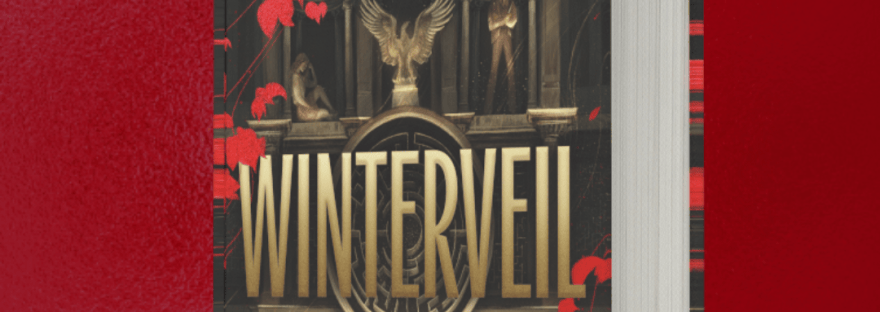
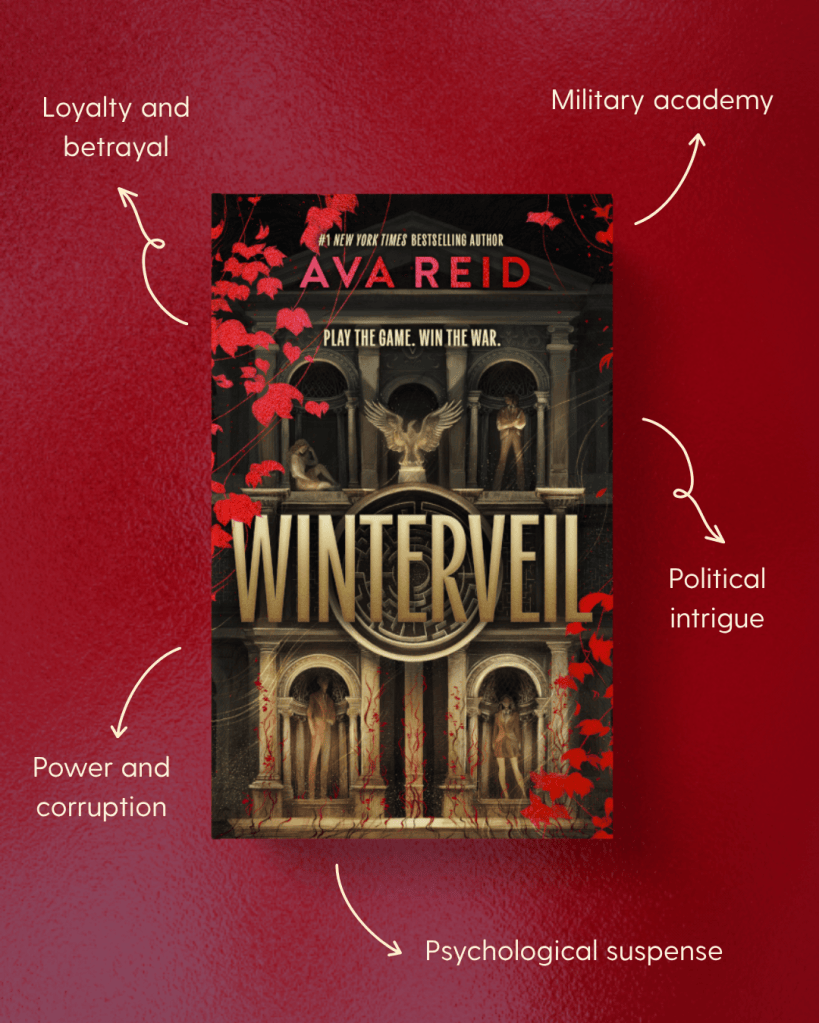
Winterveil is a young adult dystopian novel set in an alternate future where the Cold War never ended. It follows four precocious teenage criminals who trade prison sentences for admission into a secret military academy, where they are groomed for a mysterious and sinister mission. I like to pitch it as The Ballad of Songbirds and Snakes but if all the characters were students at the Capitol Academy. It’s a dystopian story from the perspective not of the revolutionaries but of the elite.
You introduce this book with a ‘Dear Reader’ message at the start, revealing Winterveil is over a decade old and you were ‘not sophisticated or practiced enough to bring out the story’s true potential’ at the time you wrote it. We love your honesty about this, especially since most authors have written stories before getting published. What inspired you to come back to Winterveil when you did?
For a long time—essentially the entirety of my professional career—“dystopian” was a word never uttered. The absolute market saturation of dystopian YA books in the 2010s led to a total industry burnout, and it was essentially impossible to sell a story in that genre. That is until fairly recently, when the pendulum has begun to swing back in that direction, due to a variety of social, economic, and even political factors. As someone raised in the heyday of YA dystopian, who got their start writing Hunger Games fanfiction, I knew I had to seize the moment if Winterveil was ever going to see the light of day.
I also knew that I was finally in a place career-wise when I could take a bit more of a risk on a premise that was unlike anything in the current market—particularly a premise that centers queer characters and queer romance. Even in my position, it hasn’t been easy, but I’m ultimately very glad to have finally been able to share this story.
How much of the story and characters changed from its original concept to what the book is today?
Very little has actually changed in regards to the characters and the world! Because I’ve been developing the characters for over a decade now, I know them like the back of my hand. I know how they would react in any given situation, which is part of what made drafting the book this time such an easy process. I could drop the four protagonists into the middle of the woods after a plane crash and know exactly what they would do (Julian is cannibalized first in this situation, by the way).
There are even some scenes that have survived from the very, very first draft, such as Julian and Klaudia’s meeting in the dining hall. All that dialogue has been there since day one. The book also always began with Julian’s arrest at City Hall. His conversation with his father over the phone is completely unchanged, and so is his key scene with Crispin (no spoilers, but if you’ve read the book I’m sure you’ll know what I’m referring to).
The dynamic that changed the most was between Nadiya and Giselle—their love has always been the heart of the book, but as a teenager who was uncomfortable with their own identity, I realize now that I was holding quite a lot back. As an adult, I’ve felt more free to center their relationship, to give them more scenes, and to emphasize how everything in the story really does coalesce around them.
Multiple POV stories are hard to pull off, and you have four very strong, unique characters to balance the narrative. How did you find writing in this way and developing each character’s voice?
I don’t think this book would have been possible if I hadn’t been developing these characters for over a decade. As I mentioned, I really do know them like the back of my hand: their fears, their desires, their conceptions of themselves, their misbeliefs, and their relationships with one another.
Winterveil is an entirely character-driven story. It’s essentially four character studies wearing the guise of a sci-fi spy thriller—which is very on-brand for an Ava Reid book.
Winterveil is set in an alternate near future where the Cold War never ended. Has that part of recent history always fascinated you?
I like to (only half-jokingly) describe Winterveil as fanfiction of my political science degree. I studied international relations, and I was very interested in the theory of realism. Realism posits that the political world operates in a system of anarchy and through the principles of a zero-sum game. It also claims that each state (which is the fundamental unit of analysis) is a “black box,” where nothing internal matters to the predictions about the state’s actions on the global scale.
This was the major international relations theory in the twentieth century, and it was born entirely out of political scientists’ efforts to explain the Cold War. Now that the Cold War has ended, other theories (such as constructivism) have risen up to take its place, and realism has fallen out of fashion.
But realism—with its roots in the philosophies of Hobbes, Machiavelli, and Thucydides—threads in perfectly with the themes I was interested in exploring in Winterveil. So it was natural to craft a setting where realism is the prevailing philosophy, which of course necessitated creating a global situation akin to the Cold War. The book’s retro-futuristic aesthetic sensibilities came entirely out of this world-building choice.
How long do you think you would survive in Valeran Academy, and who do you think you’d ally with, given the chance?
I put a lot of myself into Klaudia—she’s probably the character I identify with most out of all the characters in all my books—so I think I would do all right. I have an extremely competitive and stubborn streak, which is perfectly suited to the zero-sum game that is Valeran Academy.
Obviously, Klaudia and Nadiya would be the most valuable allies, but they’re also the least inclined to accept any alliance. So I’d probably try and get friendly with Jane and Mikhail.
This book has been comped as The Secret History meets The Ballad of Songbirds and Snakes, which we can totally see! Do you think dystopian YA literature is growing in popularity again?
Absolutely. I would even go so far as to say it is the Next Big Thing. Between the new Hunger Games movie and Veronica Roth revisiting the world of Divergent, I can only see it continuing to overtake the market in a massive way. As someone raised on classic dystopian YA, it feels very nostalgic to me, and I’m equally excited to see the way that this new era of dystopian carves out its own unique identity.
No spoilers, but Winterveil is set to be a duology. How has it been writing the sequel?
I’ve just turned in my developmental edits. It was quite a tome at 145k words (Winterveil is 125k), and there were an incredible amount of character arcs and plot threads to wrap up. I think this is the most complicated book I’ve ever written in terms of how many elements I had to balance. It’s also been quite emotional to say goodbye to these characters after so long. I really am going to miss the space that they’ve been occupying in my mind.
Winterveil is an entirely character-driven story. It’s essentially four character studies wearing the guise of a sci-fi spy thriller—which is very on-brand for an Ava Reid book.
.
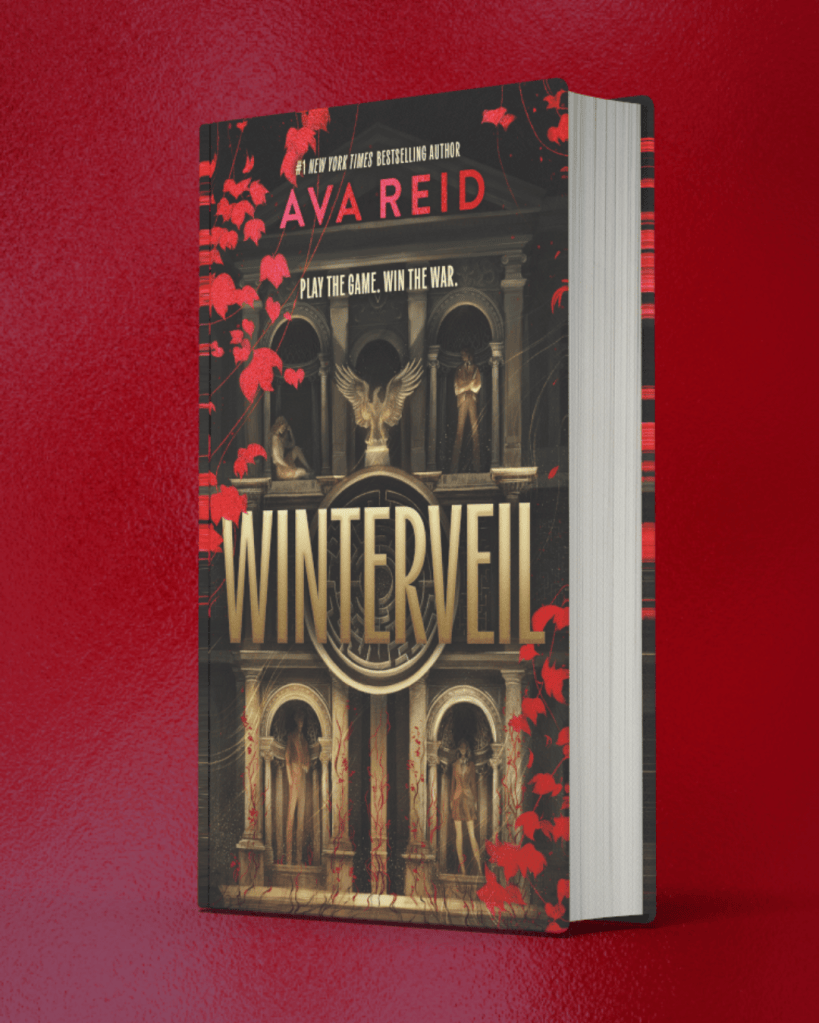
Winterveil is published by Electric Monkey and out now
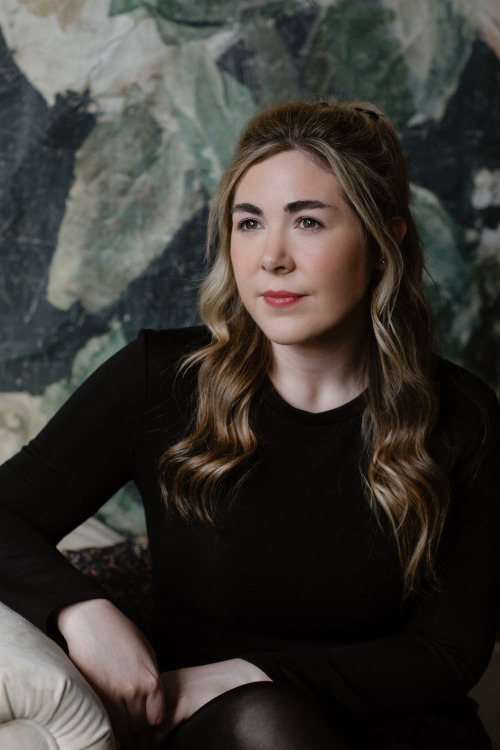
Ava Reid
Ava Reid is the #1 New York Times bestselling author of A Study in Drowning, A Theory of Dreaming, An Archive of Romance, Fable for the End of the World, Lady Macbeth, Juniper & Thorn, and The Wolf and the Woodsman. Her books have been published in over fourteen territories. She lives in the New York area. Follow her on Instagram @avasreid and find her online at tumblr.com/avasreid.