Blog, Blog series, Interview, Interviews, Writing craft

Interview: Jennifer Burkinshaw on her new YA book ‘Happiness Seeker’.

Happiness Seeker tells the story of just one week’s sixth form field trip to the beautiful but lethal Morecambe Bay. On her very first afternoon, Allie meets a mysterious lad on the shore which changes the lives of everyone involved. One reviewer has described Happiness Seeker as a ‘thriller-mystery-love story’ which does sum it up its genres neatly; I’d add in ‘tragedy’, as the prologue tells you someone is lost in the vast, dark seas of Morecambe Bay.

Places seem to be what spark a story in me, both in my debut Igloo and Happiness Seeker. Visiting my parents in Grange-over-Sands on Morecambe Bay so often; learning about the history of the Bay and seeing people, every day, still walking out onto the treacherous sands despite all the warning signs. Before my parents even moved there, though, I once took a Drama group to a hostel near Grange to rehearse, which is pretty close to the set up in the novel; however, none of my group broke every rule in the book and we all went home safely.

At the heart of the story is what could be described as a political issue which particularly concerns me, so I recruited the advice of the charity Unseen during my writing process.

Map and plan of the novel’s setting by Douglas McCleery, architecture student

I first started to feel an irresistible pull to write about twenty years ago and knew I had to start to learn the craft, an endless journey, of course. Since I still feel seventeen in my head, writing for young adults was a natural move to me; I love the intensity of feeling you need to create in YA fiction; the need to be immediate and and pacy, as well as reflective; I love how so much of YA fiction deals with first and life-changing experiences for its characters. So, I did an MA in Creative Writing for Children at Manchester Met; after that I joined the Golden Egg Academy and was mentored by Imogen Cooper. I count myself as extremely fortunate that then Debbie McGowan, my genuinely brilliant editor and publisher at Beaten Track, offered to publish my debut, Igloo, and now Happiness Seeker.

As a former Drama teacher, I couldn’t resist creating a group who, having to script a piece for their A Level, choose to write it about Morecambe Bay and the many who have drowned there over the centuries. These past tragedies soon bleed into the present of the story. I also include some reference to Arthur Miller’s A View from the Bridge which Allie is reading that fateful week; Miller is my favourite playwright but, also, the action of his tragedy has some echoes in the story happening ‘now’ in Happiness Seeker.

Map and plan of the novel’s setting by Douglas McCleery, architecture student

What was really tricky was to work out what Mareno would reveal to Allie and when – especially since he has such compelling reasons not to tell her his whole truth. I spent ages thinking what he would least mind Allie knowing and what he’d try to keep from her at all costs. I hope he intrigues the reader; I tried so hard to see him through Allie’s eyes – what draws her to him even as she finds him such a ‘dark horse’.

Allie has a painful rivalry with Courtney, a girl in her drama group who has bullied her since Allie joined the school late in Year 9. To some extent, I am like Allie – quieter, on the fringe of groups and I do remember girls at my single-sex school who could be cutting like Courtney. Allie’s best friend is Finn but unfortunately, he falls for Courtney which causes Allie a lot of heartache. I haven’t experienced having a boy as a best friend but I relished creating their deep friendship which is at the heart of the story just as much as Allie’s new relationships in Grange.

I need to get back to ‘Going West’, a story told from the POV of a member of each of three generations in a family who move from Essex back to the mum’s childhood home in Wales. I’m toying whether to tell some of it in verse …

Jennifer’s debut book is Igloo, a winter coming-of-age story of first love set in the French Alps and Lancashire, where she grew up. Happiness Seeker is her second book.
Now, she’s a bit of a nomad – loves spending time by the sea as much as in the mountains and with her growing family.
You can visit her website here.

PaperBound Magazine is an online magazine for the young, and the young at heart. We are dedicated to showcasing authors and illustrators for children’s and young adult fiction and we strive to deliver inspiring content, uplifting stories, and top tips for young and aspiring writers yet to burst on to the literary scene.

All our issues are completely free and run by volunteers, however if you would like to support PaperBound and the work we do, you can help us out by buying us a virtual book. We appreciate any support you can give us!

Don’t forget you can read with the latest issues of PaperBound Magazine – completely free – here.
Blog, Blog series, Interview, Interviews, Writing craft

Interview: Author Jennifer Claessen chats about her new book ‘The November Witches’.

The November Witches picks up Clemmie’s story immediately after all of the things she did – and feels bad about! – in October. She’s expecting a magic-free month and all of the witches are mostly miserable about it but, of course, magical mayhem is about to ensue. It’s up to Clemmie to learn to speak up for herself and the young hags though, as it’s only together that they can fight back against the fires and knights plaguing them.

Thank you so much! And yes, I was already thinking about Bonfire Night and marshmallows and a strange knight knocking on the door even as I wrote The October Witches! November doesn’t always get the festive love that October and December get but it’s an amazing month for forest walks. I moved house just before writing this book and now live on the edge of an incredible, ever-changing forest which definitely inspired the story.

My family is costume-obsessed so we usually dress up at least three times for Halloween, always cute, never creepy! This year one of our fancy dress outfits was the ‘soot sprites’ from My Neighbour Totoro which was pure chaos and so fun. Toasting marshmallows outdoors is a must of course. Like the Merlyns, I have mixed feelings about fireworks but I love a bonfire. Oh, and Pie Night, like Aunt Connie creates, is essential too! Autumn clothes are the best too – the season begins for me when I put on a scarf and a big pair of boots, or for Clemmie and her coven, a binbag.

In The October Witches, Clemmie wrestles with coming into her power but now, in a magicless November, she’s struggling with using her voice. I write generally knowing the ending as I love a big, busy, bustly finale where the covens get together and finally sort out their problems! I think this is officially a spoiler but, just between us, there’s a dragon in The November Witches, too hot to even touch, and she was a surprise!

I love everything magical! I’m currently reading The Thief of Farrowfell Hall by Ravena Guron which has a really cool magical system as the magic is edible. I love the world which is believable and compelling and the magic itself, though it often sounds disgusting to eat!

I’m always super happy digging deep into some magical research! For the whole ‘A Month of Magic’ trilogy I did lots of reading about the old, wise, male Merlin (versus my young, self-conscious and female Merlyns!) and what happened to him. I’d never even heard of ‘Avalon’ where some Arthurian scholars believe the Once and Future King will still rise again from but became pretty fascinated by it. For The November Witches I went to the Fitzwilliam Museum in Cambridge to be completely surrounded by armour and imagine what it was like to be a knight – mostly pretty uncomfortable it turns out!

Well, now we’re this deep into autumn, we have to finish the trilogy! The December Witches comes out in 2024 and I’ve just had a sneak peek of early cover designs and it is looking gorgeously sparkly and snowy! Writing-wise, I’m working on new myth-inspired tales, this time set in Ancient Greece – and in a summer holiday!

Photo by Jack Barnes

Jennifer was born in Reading and grew up a book worm. She studied literature and theatre at the University of Sheffield, the Chinese University of Hong Kong, Canterbury Christchurch University and Central School of Speech and Drama. A teacher and theatre-maker, Jennifer loves stories, especially for children, whether on stage or page. Jennifer currently works in the West End, taking children to the theatre and lives in the East End with her partner, a Dutch toymaker, and their baby daughter. She loves reading, travel and ice cream. You can find her on her yellow bike or in a red velvet seat in the stalls, applauding.

PaperBound Magazine is an online magazine for the young, and the young at heart. We are dedicated to showcasing authors and illustrators for children’s and young adult fiction and we strive to deliver inspiring content, uplifting stories, and top tips for young and aspiring writers yet to burst on to the literary scene.

All our issues are completely free and run by volunteers, however if you would like to support PaperBound and the work we do, you can help us out by buying us a virtual book. We appreciate any support you can give us!

Don’t forget you can read with the latest issues of PaperBound Magazine – completely free – here.

Blog, Blog series, Interview, Interviews, Writing craft

Interview: Rebecca Barrow on YA Thriller ‘And Don’t Look Back’

Thanks for having me! And Don’t Look Back is a twisty thriller that centres on Harlow, a girl who has spent her entire life on the run. When her mother is killed in a car accident, Harlow is left to unravel the secrets of her life and her family all alone.. 

I really love writing about mothers and daughters, and I thought it would be interesting to explore generational trauma—how a girl like Harlow is shaped by her mother’s experiences, and how she deals with that while at the same time struggling to figure out who she is in the same way all teenagers do. I really enjoy writing older YA because that time in life is so interesting—you’re on the precipice on adulthood but still a kid, at the same time. And like Harlow, a lot of teenagers are dealing with really heavy things like the loss of a parent or mental health struggles or a million other things, and I think it’s important to acknowledge those things.

It took a while to come together but once the planning was done, the writing came quite easily. I usually don’t like to plan too much because I like discovering things through the writing, but often writing a mystery means you need to plan, so it’s about finding the right balance for me. Some of the plot aspects had been in my head for years just waiting for the right story so it really was a mix of long term planning and figuring some things out as I went!

Yes, I actually really do! I don’t think I will ever run out of ideas, but I do find they sometimes take a while to come to me. I’m definitely not one of those authors who have so many ideas that the main struggle is choosing which one to work on, but I think needing to let things develop in the back of my mind can also be really beneficial. I don’t see myself ever not writing. 

I write in twenty-minute blocks and use a program called Freedom to block the internet while I write, otherwise I would never get anything done. I usually have a word count goal so I just keep writing in those twenty minute slices with breaks in between until I have the words! I like to use different playlists for different books, to help me get in the right headspace, and that’s about it! 

I have mostly always wanted to be a writer but I did entertain the idea of several other careers—nurse, fashion designer, and choreographer were the big three! But it was mostly always writer for me.

Rebecca Barrow is the critically acclaimed author of And Don’t Look Back, Bad Things Happen Here, and several others.
She is a lover of sunshine, Old Hollywood icons, and all things high femme. She lives and writes in England.

PaperBound Magazine is an online magazine for the young, and the young at heart. We are dedicated to showcasing authors and illustrators for children’s and young adult fiction and we strive to deliver inspiring content, uplifting stories, and top tips for young and aspiring writers yet to burst on to the literary scene.

All our issues are completely free and run by volunteers, however if you would like to support PaperBound and the work we do, you can help us out by buying us a virtual book. We appreciate any support you can give us!

Don’t forget you can read with the latest issues of PaperBound Magazine – completely free – here.

Blog, Blog series, Interview, Interviews, Writing craft

Interview: YA author Shelby Mahurin chats about ‘The Scarlet Veil’

Of course! The Scarlet Veil is the first in a new duology set in the same universe as Serpent & Dove. It follows Célie Tremblay, the first woman initiated into the brotherhood of Chasseurs, as she investigates a string of murders in Cesarine—all the victims of magical origin, all their bodies drained of blood. Her investigation leads her straight to the heart of a vampire lair, where she captures the attention of its cruel yet beautiful king. He has plans of his own for Célie, who refuses to acknowledge the whispers from her past that still haunt her.

Interestingly enough, no—I didn’t plan to tell Célie’s story at all. In the thick of deadline with Gods & Monsters, I even swore I’d never return to the world of Serpent & Dove again. I wanted to tell new stories with new characters; I’d even sold another duology about Greek sirens! With a little time and distance, however, I realized I wasn’t quite ready to let the world go. When I called my critique partner on the way home from my local indie the day before Gods & Monsters published, crying, she told me it didn’t necessarily need to be over—and then she asked about Célie. We both agreed her story hadn’t reached its conclusion, and I’d always wanted to write a vampire book. Their inclusion felt like a natural extension to this world. Within ten minutes, we’d plotted out a rough outline of The Scarlet Veil, and the rest is history.

Yes! I always knew The Scarlet Veil would end the way it did, and I knew I didn’t want to write another trilogy so soon after Serpent & Dove. Thus, a duology was the perfect fit!

It seems like the trickiest part for me to write is always the part I’m currently writing. Ha! In all seriousness, though, Célie is an extremely emotional and vulnerable character—a complete foil to Lou and Reid, who both avoid their emotions at all costs. I personally err more on their side of emotional avoidance, so it took a lot for me to sit with Célie and her feelings. Other scenes that are always difficult to write are action sequences; I know literally nothing about self-defence, so whenever Célie or Michal needed to physically fight someone, it meant a lot of time on the internet looking up choreography and trying to describe such technical movements in a natural way.

The easiest scenes for me to write involve romance—banter, sexual tension, a lingering look. Those are always my favorite.

I’ve always loved vampires—Twilight, The Vampire Diaries, Underworld, and True Blood were pillars of my adolescence. There’s something inherently seductive about a vampire, especially after Bram Stoker brought a refined façade to their savagery with Dracula. Maybe it’s because vampires are so powerful with their predatory speed and strength, or maybe it’s because they’re immortal. They never grow old. They live forever young, forever attractive, yet they’ve seen things we haven’t. They know things we don’t. It’s the ultimate fantasy, isn’t it? For such an all-powerful creature to fall in love with a human? And then there’s the whole business of their drinking our blood—it makes everything all the more dangerous, and don’t we all crave a little danger? I know Célie does.

It’s so interesting that you mention worldbuilding specifically because—to be completely transparent—I’ve never loved worldbuilding. Or at least, I’ve always loved it less than character work and romance. In fact, I would argue that most of the worldbuilding in The Scarlet Veil came along as a means to cram every single trope I love into this story. The vampires’ casket company, for example, was an answer to the question, “How can I realistically get Michal and Célie into one casket together?” It needed to make sense. It needed to feel like a natural progression of both the plot and world. And so, I started brainstorming, and one thing led to another, and of course vampires have always needed a way to sneak into Cesarine, right? Lou and Reid would’ve known about them in the original trilogy otherwise. And Célie needed to face her fear of caskets after what happened with Filippa in Blood & Honey. And thus, Requiem, Ltd. was born. I could think of a dozen more examples of this sort of jigsaw puzzle worldbuilding, but you get the idea.

My advice to aspiring authors would be to lean into what you love—find a way to use it, to leverage it throughout your story, and the pieces will fall into place.

Good romance requires tension. Lots of tension. For me, that means I need both an internal and external reason to keep the lovers apart. Otherwise, why wouldn’t they get together as soon as they feel that first spark of attraction? Again, those reasons also need to make logical sense; nothing infuriates me more as a reader than a flimsy excuse for two people who want to be together not being together. The reasons also need to involve personal stakes—what will happen if they do get together? It needs to have a real consequence.

I’m still drafting The Scarlet Veil’s sequel now, but afterward, I’ll be returning my attention to the Greek siren duology I mentioned earlier. I actually sold those books back in 2020 and 2021, so I’m extremely eager to get back to them!

Shelby Mahurin is theNew York Times bestselling author of the Serpent & Dove trilogy. She grew up on a small farm in rural Indiana, where sticks became wants and cows became dragons. Her rampant imagination didn’t fade with age, so she continues to play make-believe every day—with words now instead of cows. When not writing, Shelby watches The Office and reads voraciously. She still lives near that childhood farm with her very tall husband and semi feral children.

PaperBound Magazine is an online magazine for the young, and the young at heart. We are dedicated to showcasing authors and illustrators for children’s and young adult fiction and we strive to deliver inspiring content, uplifting stories, and top tips for young and aspiring writers yet to burst on to the literary scene.

All our issues are completely free and run by volunteers, however if you would like to support PaperBound and the work we do, you can help us out by buying us a virtual book. We appreciate any support you can give us!

Don’t forget you can read with the latest issues of PaperBound Magazine – completely free – here.

Blog, Blog series, Interview, Interviews, Writing craft

Interview: Michael Thomas Ford chats about his new novel ‘Every Star That Falls’

Every Star That Falls begins the day after Suicide Notes ends. Jeff returns home and goes back to his old life, but he’s no longer the old Jeff. He has to figure out what that means in terms of his relationships with his family, his friends, and his larger community. He also wants to explore what it means being an out member of the LGBTQ community, which involves finding a support group. The people he meets there change his life even more, in ways he could never have imagined a couple of months ago. 

It’s definitely surprising to me how Suicide Notes continues to find new readers. It’s also a testament to the power of social media, which wasn’t really a thing when the book first came out. Now, readers are sharing their experiences of the book on places like TikTok and Instagram, and that’s allowing it to connect with even more readers. One of the things I love most about the world right now is that the voices of readers are so strong and so powerful. They’re not waiting for anyone to tell them what to read and what they should like, they’re deciding for themselves and then spreading the word. It’s fantastic to watch this happen.

The most powerful tool for creating change is empathy. When we learn to really listen to people – particularly to people with whom we might not think we have anything in common – and hear about their experiences and what they feel, we learn to see the world in a different way. That’s how change happens. When we create barriers between us, we only see things from one perspective and it’s easier for other points of view to feel threatening. There’s much more that connects us than divides us, and learning to focus on those things while allowing for differing perspectives is what creates forward movement.

Jeff is essentially me, and I have always approached difficult situations by looking for the humour in them. I think that if you can find a way to laugh, even in the darkest moments, it creates a spark of light that grows brighter and shows you the way through. I realize not everyone appreciates this approach, because we’re all different, but for me the most effective way to deal with life when it gets hard or seems hopeless is to find the moments of joy that remind me that the darker times don’t last forever. 

In general, I don’t enjoy sequels because no matter what happens, someone is disappointed. Once someone falls in love with a character, they developed expectations of what they want for them. With Suicide Notes I wanted readers to imagine what happens to Jeff when he leaves the hospital he’s in for the whole book. But as time went on, I thought of more things I wanted to say about certain topics, and continuing Jeff’s story was the best way to do that. Also, there were some characters and events from Suicide Notes that I found readers asking about over and over again, and writing a sequel gave me the opportunity to answer those questions. 

I write for a number of different audiences, including adults and younger readers, so there’s always something happening. I’m currently finishing up a ghost-themed novel for middle grade readers, which is a lot of creepy fun. That will be out next year. And there just might be another part to the story about Jeff and his new friends coming. Readers can always find the latest news on my website: www.michaelthomasford.com.

Michael Thomas Ford is the author of numerous works for both adults and young readers, including Suicide Notes as well as some of the earliest books about the HIV/AIDS crisis and several books about the LGBTQ community. A five-time winner of the Lambda Literary Award, he has also been a finalist for the Shirley Jackson Award, the Bram Stoker Award, the Firecracker Alternative Book Award, and the Ignyte Award. He lives in rural Appalachia with his husband and dogs.

PaperBound Magazine is an online magazine for the young, and the young at heart. We are dedicated to showcasing authors and illustrators for children’s and young adult fiction and we strive to deliver inspiring content, uplifting stories, and top tips for young and aspiring writers yet to burst on to the literary scene.

All our issues are completely free and run by volunteers, however if you would like to support PaperBound and the work we do, you can help us out by buying us a virtual book. We appreciate any support you can give us!

Don’t forget you can read with the latest issues of PaperBound Magazine – completely free – here.

Blog, Blog series, Interview, Interviews, Writing craft

Interview: Children’s Author Fiona Spence-Arnold on debut book ‘Rhamni Finds Her Wings’

It’s an illustrated chapter book for 8 -10s about a butterfly and moth’s adventure in The National Forest.  

When Rhamni, a Brimstone butterfly pupates on Midsummer’s Eve, she finds herself alone, no brothers or sisters to be found. Thinking they’ve gone in search of the elusive Ghost Orchid, she teams up with new-found friend, Max, a timid Mint moth and the pair set off on a perilous adventure following messages on bramble leaves through the forest. 

When I found out Honey Craft, an independent publishers based in Leicester, were seeking a children’s writer with a connection to The National Forest, I jumped at the opportunity. Living nearby, and with a love of forests and nature, I applied and was excited to win the commission to write a short book for children as part of their MiniBEAST series.

I didn’t know that much about butterflies or moths before starting, but I certainly know more now! The research was fascinating. The characteristics of the insects and their habitats inspired the story and the characters themselves. I was fortunate to be guided by Entomologist, Graham Smith, who was also working on the project. He told us about a group of butterflies who used to be known as the Aristocratic butterflies. These include the Red Admiral and Purple Emperor. It inspired me to imagine a hierarchy in the forest led by the antagonist, Emperor Ethelbert, a Purple emperor butterfly who tries to wield power over all the butterflies and moths.

Graham also told us about the tiny Golden Pygmy moth whose caterpillars eat ‘patterns’ in bramble leaves before they pupate into moths. It inspired me to wonder, what if these caterpillars were trying to send messages through the forest on the leaves? Could they undermine the aristocratic butterflies? What could their messages lead to? It needed to be something scarce and precious. When I read about the rare Ghost Orchid flower, it seemed a perfect fit. Coupled with Rhamni’s worry about her family of Brimstone butterflies, my main character’s quest was set.

Reading a book like mine, where the characters are all minibeasts having an adventure can be a great way to encourage empathy for species other than our own, so seek out books that encourage children to think of insects and animals as integral to the eco-system and important characters in their own right. They’re more likely to want to protect them. Research has also found that when we engage with nature in a positive way, we boost our sense of wellbeing and happiness. 

Of course, you don’t have to live in the countryside to engage children with nature, especially minibeasts, they’re found everywhere! Keep an eye out under rocks, between paving stones and in quiet places in your house.  

In the summer months you’re more likely to see butterflies and moths. You can attract them by growing brightly coloured flowers in gardens or containers. Purple flowers will attract them the most as they see different colour temperatures than we do, including UV, and the colour purple stands out the best for them. Once you’ve found your bugs, you can use books or the internet to identify them. That’s where you start finding out about their characteristics and where the creative ideas can start to take root. Have fun thinking up different situations for them and make them your main characters, that way you really get to see life from their point of view. 

In my book, Rhamni and Max follow the messages on bramble leaves. These patterns on leaves are easily spotted during Autumn and winter and would make a great treasure hunt activity with children. 

We held the book launch at the Timber Festival in July and we also ran guided butterfly and moth walks, and craft activities for children. The Timber Festival is a great way of engaging children with nature as it’s held in the heart of the National Forest and has brilliant sessions and activities on different aspects of nature aimed at both children and adults. 

It was exciting working with Keith Turner, the wonderful illustrator of Rhamni Finds Her Wings, seeing how he interacted with and interpreted my story and characters. We had several meetings to share ideas, and to ask questions of the Entomologist, about characteristics and behaviours of butterflies and moths. Once I’d shared the first draft of the story with him, he started to develop his ideas about what the characters looked like.

As I redrafted, Keith asked me to think about a key feature or accessory for each character. Running this by my editor, Jess Green, I thought of big stompy boots for the intrepid explorer, Rhamni the Brimstone butterfly and a backpack for sensible Max, the Mint moth. The top hat and monocle for the villain, Emperor Ethelbert, were Keith’s ideas and made me laugh when I saw them in the final illustrations. I didn’t give an accessory to Tig, the Golden Pygmy moth caterpillar, but Keith brilliantly had him painting a ‘Mona Lisa’ with a leaf. Keith uses collage in his illustrations, and he told me if you look closely at the moon in one of the pictures, it’s actually an image of grated cheese!  

I would say tip No. 1 is read children’s books. Lots and lots of them, then some more! I read books for children of all ages, first as a reader, then as a writer, making notes, studying style, characterisation, use of voice, pacing – everything. When I was first writing for children, I would pick a book and use it as a mentor text, to really hone in on what the author was doing, how they were doing it and how I could learn from it. I’d make copious notes in the book and copy sections out to ‘feel’ and hear how it worked.

Tip no. 2  – write! You won’t get a book written if you don’t sit down and write. I often say to myself, I’ll just make twenty minutes to write, and when I’ve sat down to do that, I invariably write for longer. It’s amazing how quickly a story will emerge.

Tip No. 3 – have fun. Experiment – this is particularly good if you’re stuck with an idea. Try out new forms, styles, tenses, voice. Plus, if you’re enjoying writing your reader is more likely to enjoy reading it and when you experiment your ideas will flow.

Lastly, find your writing buddies and hold them close. They get it, they’ll be your readers, your champions, your support and you will be theirs. The more you read each other’s work and give constructive criticism, the more you learn about the craft and what kind of writer you are. 

Fiona Spence-Arnold lives in deepest, darkest Leicestershire with her family and bouncy dog.  She writes funny chapter books and exciting adventures for children. When she’s not writing stories, she works on education projects for an award-winning charity and tutors creative writing. Fiona can often be spotted catching story ideas whilst walking in the woods with her dog. She’s thrilled that her debut book, an exciting adventure in the forest, Rhamni Finds her Wings, is published by Honey Craft and is out now. 

From 14th October, it will be available to buy from independent bookshop Fox Books, Leicester. It will also be available in the gallery at DeMontfort University and through libraries in The National Forest soon.

PaperBound Magazine is an online magazine for the young, and the young at heart. We are dedicated to showcasing authors and illustrators for children’s and young adult fiction and we strive to deliver inspiring content, uplifting stories, and top tips for young and aspiring writers yet to burst on to the literary scene.

All our issues are completely free and run by volunteers, however if you would like to support PaperBound and the work we do, you can help us out by buying us a virtual book. We appreciate any support you can give us!

Don’t forget you can read with the latest issues of PaperBound Magazine – completely free – here.

Blog, Blog series, Interview, Interviews, Writing craft

Interview: Children’s Author Emma Read on ‘The Housetrap’

Of course! The Housetrap is a spooky, Scooby Doo-esque adventure where four almost-friends find themselves trapped in a strange house in the woods. The house is set for an escape room style party but for some reason it doesn’t want to let the kids go … it has other plans for them. The team have to unravel multiple mysteries and at the same time attempt to solve the puzzles and riddles left by the architect of the house, in a desperate effort to escape. The only thing they have in their favour is that they are alone in there …  

Or are they? 

For readers 9+ who like mystery, puzzles, adventure, and the odd jump scare. 

In addition to the creepy words (by me) the illustrations on the cover and interior are by Coralie Muce.

The editing process on The Housetrap was something of a metaphor for the book, in that it was a twisty, turny puzzle that needed unlocking, disassembling, and slotting back into place the right way round! I couldn’t have done any of it without my brilliant agent, Lauren Gardner, and my editor at Chicken House, Kesia Lupo who both helped me make it make sense.  

I’m not a natural plotter, although I usually formulate a rough plan in advance (plot points, pinch points etc); when it comes to writing I love the discovery approach – it’s a bit like wandering through a maze—or a house—that keeps changing and revealing new secrets. No spoilers, but there is one item in the book that the kids need to find, and I only worked out where it was by writing all the way to the end! It’s a fun method that works for me, but it does mean edits are usually hard work!  

Places I’ve been, and seen, always find their way into my books, and The Housetrap is no exception. The idea for the house itself, and the entire story really, came from a beautiful but declining hotel in Rome. Haphazardly built, it had several mezzanine levels, rooms that were unexpectedly connected, and stairs that didn’t seem to go where you thought they should.

As I wrote, I augmented it with fictional houses and hotels (the Overlook won’t be a surprise, I’m sure!) But it was another, real-life, hotel which lent the finishing touches, including all the taxidermy animals and mounted deer heads. This was another, past-its-best building, hidden in the New Forest in Hampshire (a forest created for a king, like Badwell Woods in the novel.) 

The Housetrap is set in Suffolk, where I grew up, which is home to Thetford forest – a magnificently huge place, which, when I was a child, I truly believed a person could get lost in forever. 

Character-wise, I think the only one who is drawn from life is Deliah. There is a lot of me in her – like her I was embarrassed of being smart; I thought it made other people uncomfortable so I masked it … being clever wasn’t cool where I went to school! In Deliah I wanted to create a character who could work through those feelings and grow to be proud of her intelligence. 

In Milton the Mighty/Megastar, I was keen to show the characters as realistically as possible, their spidery movement, physiology and, as much as possible within the bounds of the story, their behaviour. In The Housetrap, there’s not a lot of science directly on the page, but I still examine all my scenes to make sure they are logical, within the rules of whatever supernatural power is in play.

More generally, I find a wealth of story inspiration in science, from pure sci-fi ideas, to cli-fi, to the natural world and way beyond: the first story I ever had published was inspired by a conversation about ghosts on The Infinite Monkey Cage (a science comedy podcast with Professor Brian Cox) which makes it feel like I’ve come full circle! 

It might seem anathema to some to consider writing a competitive sport, but as an aspiring writer, I entered every comp going! My first win was a Twitter micro fiction competition (back in the days of 140 characters!) and I kept going until I hit the amazing heights of the BCNA shortlist. Writing competitions aren’t for everyone – the odds are not ever in your favour and the likelihood is you will fail. And if you do list, or even win, there are no guarantees of success.

But … if you can stomach with that, competitions provide interesting benefits (besides the chance to walk away with a prize). They are great motivators, providing hard deadlines of the sort you might get from a publisher; they force you to scrutinise your work, helping you become a better editor; and they acclimatise you to having professionals read your work and, if you’re lucky, critique it.  

If you’re going to enter competitions, my advice is to try and enter with friends; turn it into a team sport, where successes can be vicarious, and failure can be shared and contextualised. Also, be clear on why you’re entering and manage your expectations. What do you hope to accomplish? Achieving a listing, or a notable mention is a fantastic addition to your query letter, and getting used to rejection will set you in good stead for any writing journey. 

When it comes to The Housetrap, my main desire is for readers to have fun. I wanted to write a thrilling adventure, something that makes you gasp and squeal, with delight and just a little bit of terror – like riding your bike super fast downhill. But there are some messages to take away too – I’ve already mentioned Deliah’s smarts, but also I want readers (perhaps especially girls) to see that maths has value. I volunteer at my local primary school, helping out with maths and I see too many girls in KS2 with self-imposed barriers to the subject. I hope the book speaks to them, just a little. 

More broadly, appropriately scary books can be beneficial to children’s emotional development. There are a lot of studies across this subject but in a nutshell, readers can experience fear, almost practice it, in a safe environment and learn to recognise their own personal tolerance for risk. One of my favourite pieces of feedback for the book has been from readers wondering what they would do in the same situation. How would they respond, how would they escape? Allowing readers a ‘run-through’ like this, of their feelings, allows them to be challenged and grow emotionally, in a safe environment. 

As much as I’d love to scare the living daylights out of Deliah and the gang again, in all likelihood it’s probably not going to happen. If there were to be a sequel, I do have a seed of an idea as to what that might look like, so never say never – it might turn up as a short story or a freebie on my Substack!  

Emma Read is the author of The Housetrap, and the Milton series (Chicken House), including Milton the Mighty, one of The Times Best Children’s Books of 2019 and shortlisted for the Bath Children’s Novel Award.
She loves all things spooky (and spidery!) and can often be found walking through her local graveyard … but only in daylight. Like Mark Gatiss, she doesn’t believe in ghosts, but is scared of them. Connect with Emma at @emmydee73 (Twitter), @ediereadie (Instagram), subscribe at emmaread.substack.com/ for exclusive content, and get in touch at emmareadauthor.com   
Like his career, Steve’s writing is filled with tech and engineering, although his speculative thrillers tend to have higher stakes and fewer meetings. Before he found himself advising companies on digital transformation, Steve was a copywriter, a magazine editor, a communications director, a product designer and a webcaster, though not at the same time. Home is South London, where he lives with his wife and teenage daughters. They wish he’d stop saying, ‘What if…’

Stay tuned for Steve’s review of The Housetrap in our autumn/winter issue, coming soon!

PaperBound Magazine is an online magazine for the young, and the young at heart. We are dedicated to showcasing authors and illustrators for children’s and young adult fiction and we strive to deliver inspiring content, uplifting stories, and top tips for young and aspiring writers yet to burst on to the literary scene.

All our issues are completely free and run by volunteers, however if you would like to support PaperBound and the work we do, you can help us out by buying us a virtual book. We appreciate any support you can give us!

Don’t forget you can read with the latest issues of PaperBound Magazine – completely free – here.
Blog, Interview, Interviews

Interview: Millie Florence on being a Teenage Published Author, Navigating Negativity, and Middle Grade Book Deals

PaperBound Magazine are thrilled to feature a blog Q&A with author Millie Florence.

This interview has been composed and written by freelance writer Cailey Tin.

Q&A with Millie Florence

You published your debut book, Honey Butter, at age thirteen. What was the process of writing and publishing it like for you? Were there any resources or help you got at the start?

I may not have finished Honey Butter without NaNoWriMo. NaNoWriMo stands for National Novel Writing Month, which is every November. It’s the challenge to write the entire first draft of a novel in thirty days. Their official website provides you with tools to track your word count goal, advice, and inspirational pep talks to keep you motivated. The program was definitely what pushed me to write the first draft of Honey Butter. 
I’ve been obsessed with writing and storytelling for as long as I can remember, but always struggled to finish anything longer than a short story. My goal in writing Honey Butter was to write something a step up from a short story. Something simple and short and sweet, but something I could write with excellence. Something I could be proud of. Although all my projects before this had been epic fantasy and sci-fi novels, for this I purposefully kept myself to a limit of 30k words and a contemporary story set in an ordinary suburban neighborhood. 
I have a video on my YouTube channel about the process of writing Honey Butter, which I highly recommend. I explain everything more eloquently and in depth there, with some advice for young writers who are experiencing the same struggles I did! 
So far, yes, I have read my book reviews, but that’s mostly because there aren’t very many of them. Due to having a smaller number of reviews, there also aren’t many hateful ones. I anticipate receiving a lot more reviews once my traditionally published books are released, because those companies have a built-in audience that I don’t, and it has been on my mind lately, how I should approach reviews once I start getting large numbers of them. 
Abbie Emmons, an author and YouTuber I follow, mentioned getting in a very bad mental place with reviews when her first novel came out. She read every single review for a while, and whether she had a good day or a bad day depended on the reviews she got. Obviously, that’s not healthy. 
I think it’s a balance. You need to be able to take feedback and hear what your readers are saying, but you can’t let it consume your life. It comes down to having confidence in your story. You have to be able to see through both flattery and hate to recognize your story for what is truly is. 
It’s been a really interesting experience, and I love both! I love the control of self-publishing and the fact that I get to be intimately a part of how the book is produced. Still, traditional publishing has a wonderful collaborative nature to it, and it’s amazing to work with such talented and hard-working individuals. The process and experience with traditional publishing can also really change depending on what company you work with. 
In the future, I’ll choose a route depending on what I think each book needs. 
My favorite part of writing is when the characters come to life. If you develop characters well, they’ll sort of start talking and acting on their own, or, to put it in less whimsical terms, you know exactly what they would do or say in any situation. Thus, all you have to do is create the right situations, put your characters in them, sit back, and type as fast as you can. It’s like building a marble run and then experiencing the satisfaction of watching your marble zoom through it exactly as you intended. Those are my favorite scenes to write, with characters bouncing off each other and their environment until they land exactly where they need to be to further the plot. 
Of course, sometimes it’s not that easy. Sometimes you’ve miscalculated the placement of a few pieces in your marble run, and when you put the marble in it falls out off the track, or goes in a different direction entirely. That’s when adjustments need to be made.
I always write my first draft as quickly as possible, which takes one to three months, depending on the length of the draft. I have to strike while the iron is hot, so to speak, and take advantage of that initial burst of inspiration. The drafts after that vary, they can less or more time than the first draft, it all depends on what changes I decide to make. I alternate between receiving feedback from beta readers and author friends, and implementing the changes until I feel that the story is the best it can possibly be! It usually takes me four or five drafts to get there. 
When I’m writing a first draft I spend anywhere from one to five hours a day writing. That’s the most intensive part of the process. Once I get to later drafts progress it a bit more difficult to measure. I’ll often go days or weeks without writing in drafts two and three, but I never stop brainstorming and thinking through the best way to improve the storyline. That way, when I do sit down to write, I don’t spend too much time staring at my blinking cursor. Half the battle is sorting out what I’m going to write. After that, it comes pretty easily to me. 
I always knew I wanted to publish my books someday, so I would say it felt a lot more exciting than intimidating. There was definitely a lot to learn, but I loved every minute of the learning process. I started out by researching publishing in-depth and eventually settled on using Ingramspark for my self-publishing distributor. Later, when I wanted to explore traditional publishing, I did a lot of research on how to query and the different pieces that went into that avenue. 
Getting distracted. Our modern world is full of distractions, and writing, by nature, requires you to be bored enough to come up with your own imaginative entertainment. When social media is always at my fingertips, that can be very difficult. Those distractions have always been a struggle for me, but I learn and grow every day! 
I follow my inspiration, and so far all the story ideas I’ve come up with have been middle-grade! If I get an idea in the future that better lends itself to YA, then yes, I’ll write a YA book, but otherwise, I don’t have any plans to. I do have plans to write more picture books in the future! Picture books are a very special medium to me–they’re like an art gallery and a short story rolled into one. I can’t draw, but I love working with people who can, and I love the challenge that comes with telling a story in such a short format. 
A stage actor. 
I’ve been acting in community theater since I was very young, and I absolutely love it. The collaboration with the cast and crew and the opportunity to bring a character to life is a very special experience. I love working with fellow creative people, and I love putting on a show. There’s something beautiful about hearing your audience’s reaction in real-time, and for a few hours, in one room, a group of strangers are all fully immersed in a story together.
Yes! I’m a big fan of middle-grade, and I always will be. Two books that were influential to me at a young age were Anne of Green Gables by L. M. Montgomery and A Little Princess by Frances Hodgson Burnett. I listened to those two audiobooks over and over and over again when I was little, and they definitely instilled in me a sense of wonder for everyday life, and the importance of imagination and hope. 
One of my favorite quotes about storytelling is “The two most engaging powers of an author are to make new things familiar, and familiar things new.” Anne of Green Gables and A Little Princess are in the category of making familiar things new. 
In the category of making new things familiar, I also grew up reading Harry Potter, The Lord of the Rings, and The Chronicles of Narnia
My favorite book of all time is The Mysterious Benedict Society by Trenton Lee Stewart. It checks all the boxes of everything I love in a middle-grade novel and executes them to near perfection. Mystery and adventure, lively characters, subtly quirky narration, impossible odds, and yet everlasting hope. It’s an adventure that is fun and fantastic, while simultaneously holding great depth and wisdom that leaves a lingering warmth in your chest when you finish. It’s the sort of book I want to write!
Quite honestly, I would say “Don’t worry so much.” 
I’m very passionate and motivated when it comes to my writing, but there is a dark side to that when doubts start to creep in. What if I don’t make it? What if my writing isn’t good? What if it is good but it doesn’t matter because it gets lost on the internet and no one ever reads it? What if I do everything right, but I just wasn’t lucky enough? What if I’m still here in fifteen years? 
But worrying about those questions doesn’t answer them. Doubting if a dream will come true doesn’t make it any more likely to do so. Worrying doesn’t make a difference in the outcome, but it does make a difference in our mood, and not in a good way. What does make a difference in the outcome is excitement and creativity and passion for the stories we write, and you’ll live a happier life along the way. 

Millie Florence

Millie Florence is an adventurous homeschooler who published her first book, ‘Honey Butter’, at age 13, and another middle grade book at age 15. Currently, she has two books on the way. She loves sushi, zip lines, and just about all things yellow. 

Connect with Millie on Instagram: @millieflorenceauthor.

Cailey Tin

Cailey Tin is an interview editor of Paper Crane Journal. She is an Asia-based staff writer and podcast co-host at The Incandescent Review, a columnist in Incognito Press and Spiritus Mundi Review, and her work has been published in Fairfield Scribes, Alien Magazine, Cathartic Lit, and more.
Her work is forthcoming in the Eunoia Review and Dragon Bone Publishing. Visit her Instagram @itscaileynotkylie.

PaperBound Magazine is an online magazine for the young, and the young at heart. We are dedicated to showcasing authors and illustrators for children’s and young adult fiction and we strive to deliver inspiring content, uplifting stories, and top tips for young and aspiring writers yet to burst on to the literary scene.

All our issues are completely free and run by volunteers, however if you would like to support PaperBound and the work we do, you can help us out by buying us a virtual book. We appreciate any support you can give us!

Don’t forget you can read with the latest issues of PaperBound Magazine – completely free – here.

Blog, Interview, Interviews

Interview: Julia Turk talks her Debut Trilogy, Writing Dystopian Novels, & Publishing Deals

PaperBound Magazine are thrilled to feature a blog Q&A with sci-fi and fantasy author Julia Turk.

This interview has been composed and written by freelance writer Cailey Tin.

Q&A with Julia Turk

What was the core idea that inspired your debut novel, Lone Player? And its name is also super cool, where did you get it from? ?

I found my inspiration for Lone Player when I was about twelve years old. I was scrolling through Pinterest and found a photo of a playing card tattoo that I really liked. It got me thinking – what if everyone had playing card tattoos? What would that society look like? I eventually tied in population control, and after that I developed the system of Running and Chasing.
While this is what inspired the world-building aspects for me, at its core, I suppose the main thing that inspired Lone Player was the concept of a Runner and a Chaser actually knowing each other. I was really interested in this relationship dynamic. I kept thinking, how can you unlearn that kind of hate? Or is there even hate there to begin with? I wondered what would drive a person to Run or Chase in the first place, even if they knew the consequences, which is how I eventually came up with the relationship between Ren and Eddie.
As far as the title goes, it actually took me quite a bit of time to find one that I felt suited the book best. I tested out a lot of different names, but I didn’t come up with Lone Player until I was scrolling through a list of playing card terms, and that one immediately caught my eye. The term refers to an independent card player, essentially, and I thought it really tied into the overall theme of the book. 

When did you know that you wanted to be an author? Did you write any books before Lone Player ?

I’ve been a writer for as long as I can remember. I’ve spent my whole life planning story ideas and starting books I never finished. Storytelling is just something I’ve always done and I’ve never not been writing something.
I’ve always wanted to publish a book. However, in terms of my career, I didn’t realize I wanted to be a professional author until quarantine. I grew up wanting to be a marine biologist so I could study cartilaginous fishes (sharks, rays, etc.), but after my chronic Lyme disease and co-infections took a turn for the worst in the middle of my sophomore year in high school (which was also the start of quarantine), I realized a physically-demanding job like that might not have been too realistic for me, especially after I had a couple of major leg surgeries. Plus, while I love science, I hate the math that comes with it.
So during this time, when I was about fifteen, I realized I wanted to be an author instead. Writing was the perfect solution. It was flexible enough to work around my illness and bad legs, and I just really felt drawn to it. Maybe I’ll do something else on the side someday to keep me busy— like working the front desk of some haunted Victorian-style inn or antique shop— but writing is at the centre of what I want to do.
I haven’t written any books before Lone Player. As I mentioned before, I grew up writing, but I never actually finished an entire project until this book. I don’t think I would have finished it if it weren’t for the Lost Island contest, which gave me the deadline and pressure I needed to get over my fears and simply write. I still can’t believe my very first (and very rough) manuscript won, but to me, it’s an important symbol of what might happen if you do things that scare you now and then.  

What would you say is your interesting writing quirk?

I’d say my most interesting writing quirk is the fact that I dream in stories. A lot of book ideas come to me in my sleep. Sometimes it’s literally like I’m watching a movie. There are characters played by actors, plots, movie trailers, a soundtrack, even a credits sequence at the end. It’s really bizarre. One of my most vivid ones even has its own folder in my Google Drive as a potential writing project.

What is the most difficult part of being a writer for you?

For me, the most difficult part of being a writer is the insecurity. Thanks to my anxiety and OCD, I struggle with a really bad imposter’s syndrome. I always feel like the things I’m writing make no sense, or that I’m upsetting people, or that I’m just not good. Another thing I worry about is that my story has already been written, or that it’s too simple.
There are so many worries a person can have as an author, especially if you’re a perfectionist like me. But by writing through the worries, I’ve learned a lot about how to handle my fears and perfectionism. The best thing you can do if you struggle with something similar is to write anyway, even if it’s scary. 

Since you’re also an avid reader, what books inspired aspects of your own projects? Do you read the same genres you write?  

Yes, I’m definitely an avid reader! Scythe, The Fifth Wave, and The Hunger Games were definitely huge inspirations for Lone Player, since I read those books in middle school (around the same time that I developed the idea for LP).
I usually read the same genres I write, mostly fantasy. But I’ve also been enjoying a few contemporary romances lately, which isn’t something I expected. 

On the topic of books, who are your favourite authors and what aspect of their writing do you admire the most?  

My favorite authors include Holly Black of course, Brandon Sanderson, and Margaret Rogerson, among many others. I love the characters and fairy folklore in Holly Black’s work, the world-building and intricate plots in Brandon Sanderson’s, and the really immersive, almost Ghibli-esque quality of Margaret Rogerson’s writing.

If you could tell your younger self anything writing related – whether it be publishing advice, drafting tips, anything, what would it be?

If I could tell my younger self anything writing-related, I think I’d tell myself to just write. I know you’re afraid. I know you’re scared of getting things wrong or not being good enough. But write anyway, because there is no such thing as bad writing. You can’t edit a blank page, and you can’t improve without actually getting the words out first. Always remember that writing is healing, and writing is growth—and it’s okay to do things that scare you every now and then. 

Julia Turk

Julia Rosemary Turk is an author and artist based in Northern California. She loves all things creative, and she spends her days downing matcha lattes and writing stories. Julia is the winner of the Lost Island writing contest and will have her debut novel, Lone Player, published by Lost Island Press this July 2023.

In addition to writing, Julia loves spending time with family, playing cosy games, and listening to indie rock. She’s been battling chronic Lyme disease since childhood and considers her illness a crucial part of her identity. 

Connect with Julia on her website, her own blog, and follow her on Instagram: @juliarosemaryturk.

Cailey Tin

Cailey Tin is an interview editor of Paper Crane Journal. She is an Asia-based staff writer and podcast co-host at The Incandescent Review, a columnist in Incognito Press and Spiritus Mundi Review, and her work has been published in Fairfield Scribes, Alien Magazine, Cathartic Lit, and more.
Her work is forthcoming in the Eunoia Review and Dragon Bone Publishing. Visit her Instagram @itscaileynotkylie.

Lone Player is out now and published by Lost Island Press.

PaperBound Magazine is an online magazine for the young, and the young at heart. We are dedicated to showcasing authors and illustrators for children’s and young adult fiction and we strive to deliver inspiring content, uplifting stories, and top tips for young and aspiring writers yet to burst on to the literary scene.

All our issues are completely free and run by volunteers, however if you would like to support PaperBound and the work we do, you can help us out by buying us a virtual book. We appreciate any support you can give us!

Don’t forget you can read with the latest issues of PaperBound Magazine – completely free – here.

Blog, Interview, Interviews

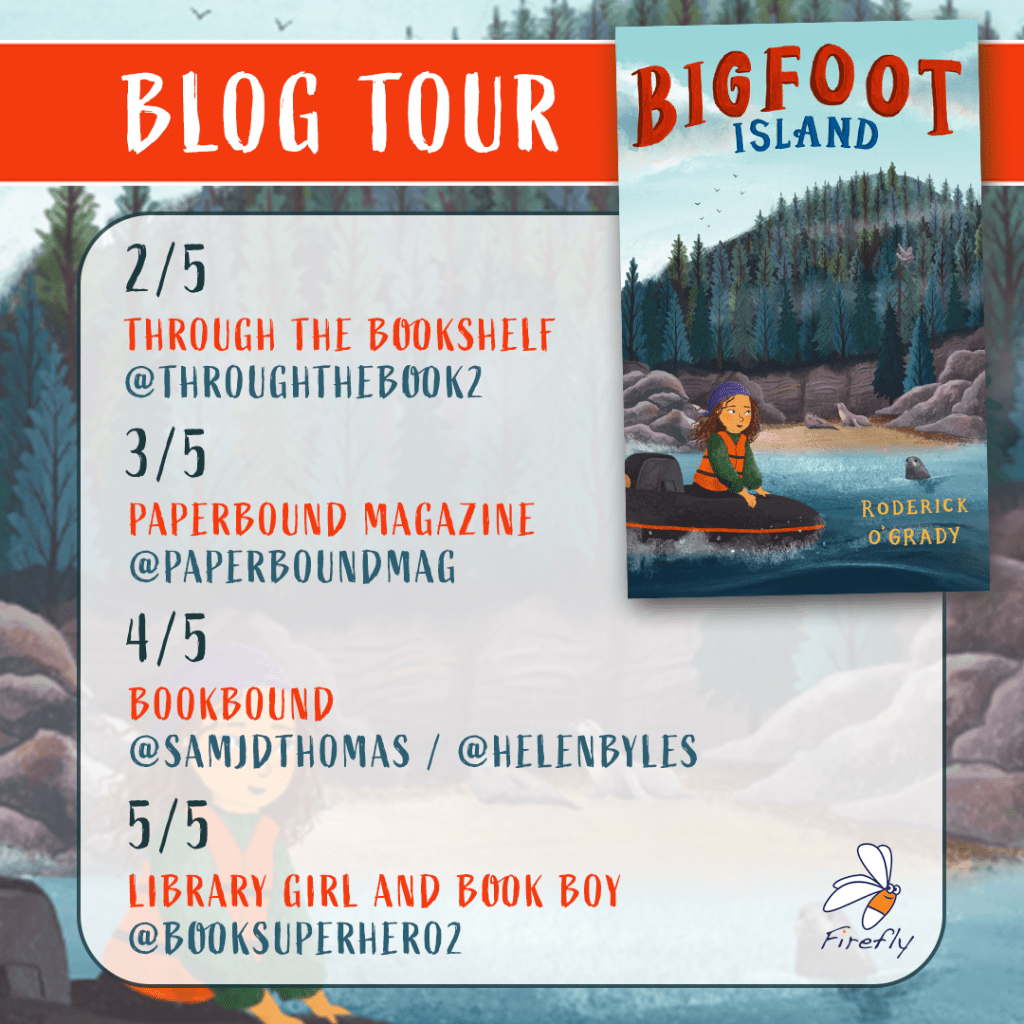
Blog Tour: Bigfoot Island by Roderick O’Grady

PaperBound Magazine are thrilled to be part of the Blog Tour for Bigfoot Island.

We were lucky enough to interview Rod all about the inspiration behind his books!

Q&A with Roderick O’Grady

Can you tell us a little bit about your new book Bigfoot Island (and Bigfoot Mountain for those who haven’t read it yet – no spoilers!) and the inspiration behind it?

Let’s start with what inspired me to write BFM. I had never written a book before and the only subject at the time that really intrigued me was that of Bigfoots also known as Sasquatches, also known as Sabe (Saa-bay). In fact, every Native American tribe has a word in their language for the big hairy forest people that, according to them, have always lived on the American continent. I had happily fallen down the rabbit-hole of ‘Bigfoot Research’. In Bigfoot Mountain we meet the four humans living in the Pacific North West in cabins near the sea at the foot of a mountain – Minnie, her step dad Dan, their neighbour Connie and her young son Billy.
We also meet eleven Bigfoots who are looking for a new forest home as wild fires forced them to leave their caves in the mountains to the east. Minnie and the young Bigfoot Kaayii (who is nearly seven foot tall) don’t become friends, but they do help each other. In Bigfoot Island, a family comes to stay in one of the cabins who go hunting on the mountain. Minnie is worried that their paths will cross with Kaayii. The young Bigfoot has problems of his own when an angry rogue Bigfoot arrives on the mountain and starts wandering close to the humans. Kaayii needs help and, again, Minnie is able to provide it.

What made you decide to write about Sasquatches?

The evidence for their actual existence has been increasing in recent years. I’ve read the DNA report which says they are an unknown relic hominid, not yet recognised by science. If they do indeed exist then I think the way I describe their way of life might be quite accurate. They live in family groups, are self-appointed stewards of the forest, and can communicate telepathically.
Did you have to do a lot of research to write your books? If so, what was the most interesting thing you discovered?

I did a ton of research and am still learning. I wanted to set the story in a temperate rainforest where animals thrive as it has high rainfall and therefore plenty to eat. So, I researched the area of Western Canada in British Colombia so that the descriptions of the flora and fauna are accurate. I’ve never been there, though I hope to visit one day. The most interesting thing I discovered is that many eye witness accounts of seeing Bigfoots in the woods describe how they seem to be able to make themselves go invisible, possibly by raising their vibration. And the footprints they leave in mud and snow can suddenly stop, like they just disappeared in to another dimension!

What do you hope readers will take from these books?

I believe that the more children understand about nature, the more they will want to protect it. I hope I have described the forest, the sea shore, the islands vividly enough that they will want to go out in to nature and explore our wonderful natural world.

What do you enjoy most about being an author?

I really enjoy meeting children in schools, and inspiring them to think about maybe writing a story one day.

If you could give one writing tip to an aspiring author, what would it be?

Just start writing. Your first idea might not be the one that will end up being a great story but the process of writing will pull from your subconscious mind incredible ideas, charming characters, fun dialogue and extraordinary places ­- if you just let it.

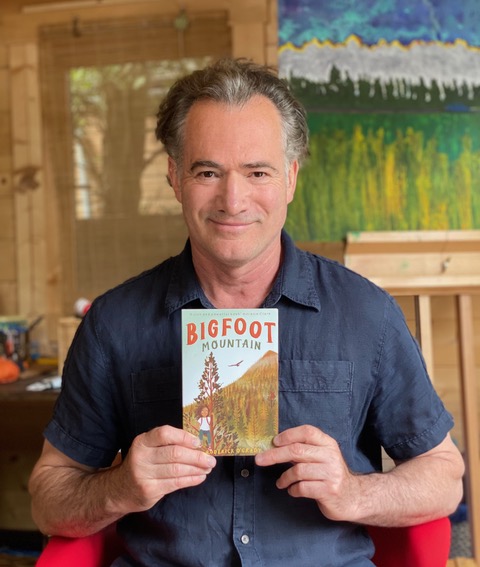
Roderick O’Grady is an actor who has worked in London and New York. His stage play, ‘A Foolish Fancy – How not to Get Ahead in the Theatre’ was a Time Out critic’s choice on the London Fringe. He has voiced the audiobook for Bigfoot Mountain, his first children’s book.

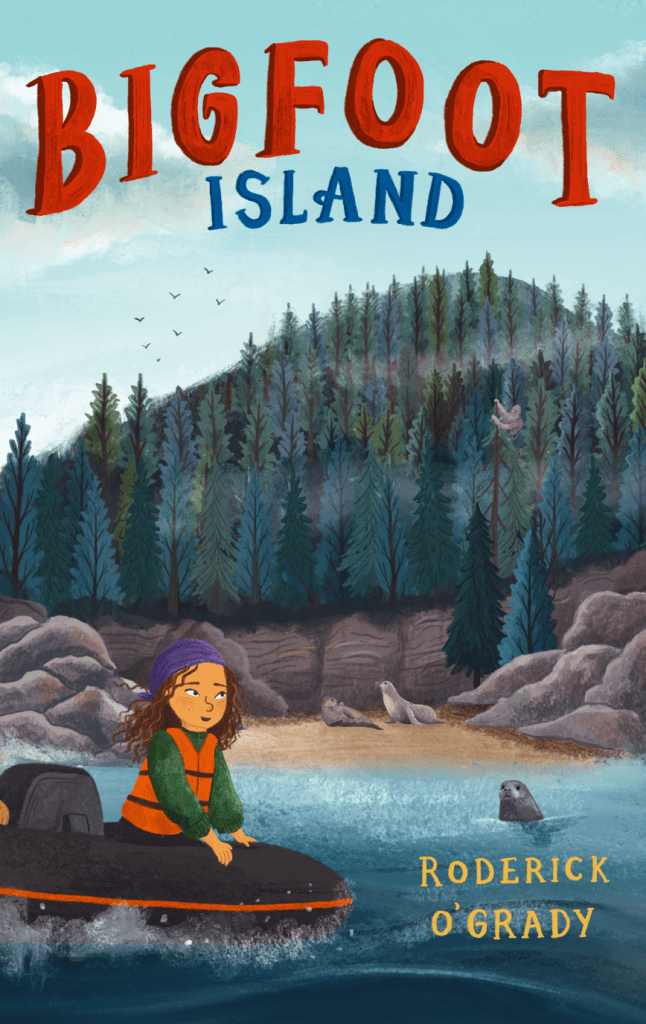
Bigfoot Island

When Minnie spots a white boat bringing strangers to the cove below her cabin, she fears the hard-won peace of her tiny community at the foot of Bigfoot Mountain will be shattered.
Kaayii too has to deal with an intruder on the mountain and, injured, needs to reach his family across the water. The two inhabit separate worlds but must find a way to work together to avoid disaster and protect the people and places they hold dear.

Bigfoot Mountain and Bigfoot Island are out now and published by Firefly Press

We have loved being a part of the Bigfoot Island Blog Tour!
Don’t forget to check out the other great blogs this week, for lots more from the world of Bigfoot Mountain!