Uncle Zeedie - The Blood Texts
article, Blog, Blog series, Bookshelf, on writing, Writing craft

Halloween guest post: 3 Horror Writing Tips by Colm Field

Of course, those things aren’t objective really. What scares one person won’t scare another, and my fears might well bore you. You might have many goals in your writing, might even bristle at my philistine summation.

Yet while you’re probably right, and a writer should never over-codify their process lest their work lose its soul, I promise that the following 3 tips can help your next devilish inspiration find a page to torment.

Like all writing ‘rules’, they should be read then shoved back to the same part of your mind that remembers to brush teeth and brake at red lights. I hope they’re of use.

Yep, I’m still being simplistic. But if you’ve had a great idea for a horror, only to find that it’s not getting any further in your head, you could do a lot worse than studying these three aspects of your story; the Monster, the Scares, and the Cares. The Monster is the thing we are frightened of, the Scares are the moments we, um, get scared, and the Cares are the characters we really don’t want to see hurt. I promise you – your story has them all, somewhere.

And not necessarily in equal measure. Come up with an exciting, memorable Monster, for example, and you might decide to inflict it on characters so tropey that their terror is immediately recognised, without all that effort spent getting into their psyche. Good for you – don’t worry about judgement here, we’re horror fans, we’re past all that.

But if you’re story still falls flat, then perhaps we do need more on the Cares … or maybe just more Scares. As Howard Hawks almost said, ‘A good horror is seven terrifying moments… and no boring ones.’

Or, you might have put all your effort into writing a complex and compelling love story, with characters rich in pathos and a drip drip drip of intangible dread. Wondering why your reader drifted off halfway through? Perhaps the threat to those characters is too wispy.

Develop your Monster a little more, give them some teeth to go with all that talk. Because if you exclude one part of this unholy trinity entirely, it will be missed.

You know this already, of course. The thing that goes bump in the night can be a very human bully, a voracious plant, your protagonist’s own id. They may turn out to be not a monster at all, but horribly misunderstood. It’s common knowledge, so why am I telling you about it here?

Well, for me, it’s the question itself that is of interest. Who is scaring us here? Why are they scary? What does our fear of them say about us?

Sometimes the answers are straightforward. I just don’t want to be eaten! If your Monster is a straight up heinous villain, then don’t worry, there’s nothing wrong with that.

Indeed, adding layers of sympathy can run the risk of excusing their crimes. I’m sorry about your parents’ divorce, Billy, but you just cut off my arms with a plasterboard saw.

But if the answers run deep? Then asking these questions can make your story truly profound. In T. Kingfisher’s book What Moves The Dead, an organism that causes a sinister change to its victims is reflected in other transformations taking place; through war, crumbling inheritance, and cold science.

Indeed, the one constant in the book is that of the protagonist’s gender fluidity; a fact, nothing more nor less, a source of comfort and familiarity while all our other assumptions are wrecked.

I won’t give anything away, but my first thought upon finishing the book was, Was that about a monster? I couldn’t decide. I still can’t.

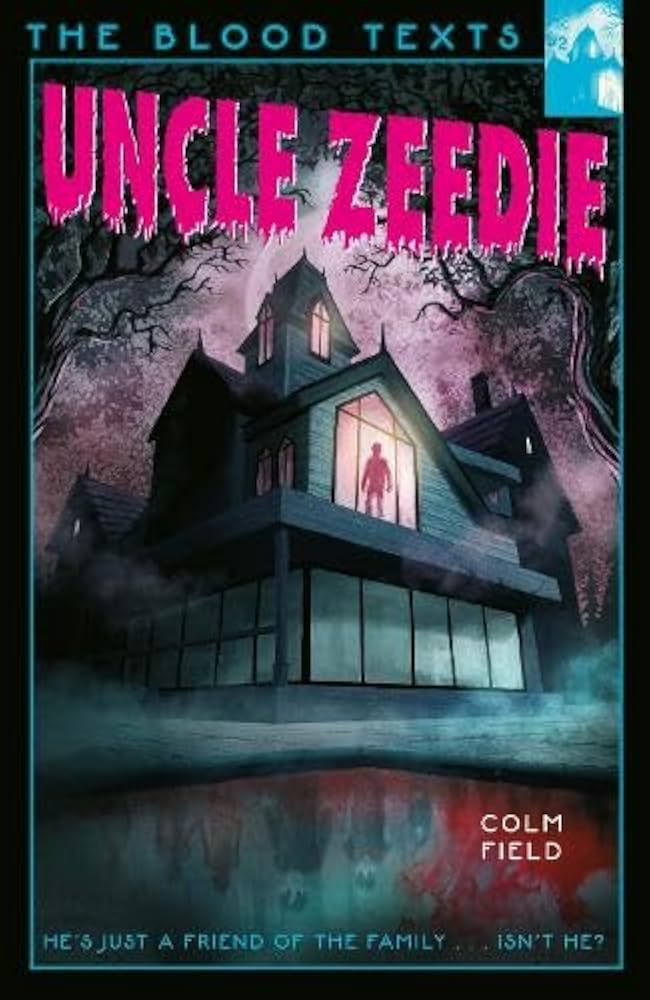
In my own Uncle Zeedie (plug alert!) the teenaged protagonists are scared that their family friend may be a serial killer. The story poses similar questions: If somebody is weird, does that make them dangerous, or you narrow-minded?

If you choose to ignore a red flag, are you foolish or simply trusting? The answers aren’t simple, but I loved writing the debate.

It’s a dark, dark night, in a dark, dark wood. You know your monster, you know your characters, you know their end. What Scare will you choose?

If writing is craft, then Horror can be Lego, provided you learn your blocks right. Jump scares, atmospheric scares, paranormal activity (the activity, not the film), repulsion… there are so many different tools at your disposal, provided you use them correctly.

Is this midnight nature walk early in the story? Then why not a terrifying mirror reveal, or even just a simple jump scare? Something leapt from the bush and… end of chapter. Yeah, it’s a cheap cliffhanger… but it’s only cheap if you do it again, and remember: we’re horror fans! We like a bit of tacky now and then!

Ooh, but later? After we learned the myth of the beast, the foul curse, the soul-sucking spectre? After the best friend has died horribly?! Right then, a jump scare might be as welcome as a fart joke at a funeral.

Now it’s time to bring in the power tools instead, bring in some repulsive body horror, or a bad trip-inducing surrealism, or maybe throw in the Monster’s POV…

I could go on, and you could probably think of more that I would miss. Scares are tools, don’t be afraid to treat them as such.

With these tips, please don’t think I’m reducing the joy of writing into an AI prompt. Horror is not an objective science – it is an ethereal art form that revels in the uncertain, and loses its potency when stripped to bare and cynical mechanics.

But the scary books that have gripped me of late – say, Boys In The Valley by Philip Fracassi, or Deadstream by Mar-Romasco Moore – they featured these recognisable elements, delivered with a new and terrifying gusto.

Should you be struggling with this wicked masterpiece, and these bare and cynical mechanics can offer you a way through that struggle, then please, know this. You are writing for horror fans. If anybody won’t judge, it’s us.

Uncle Zeedie is weird, but at least he’s rich and his house is amazing.
That’s what George and Lacey tell themselves when they arrive at his isolated mansion in the Welsh woods. Only, something here is worse than weird.
Uncle Zeedie seems unhinged, serving them rotten food, and skulking around at night. The house is decaying, blood stained, and stinks of sour milk. And George is seeing kids that aren’t there. They’re dead, these kids.
And if the rumours are right, Uncle Zeedie is the one who’s killing them.
The players are in place. The stage is set. Curtain up.
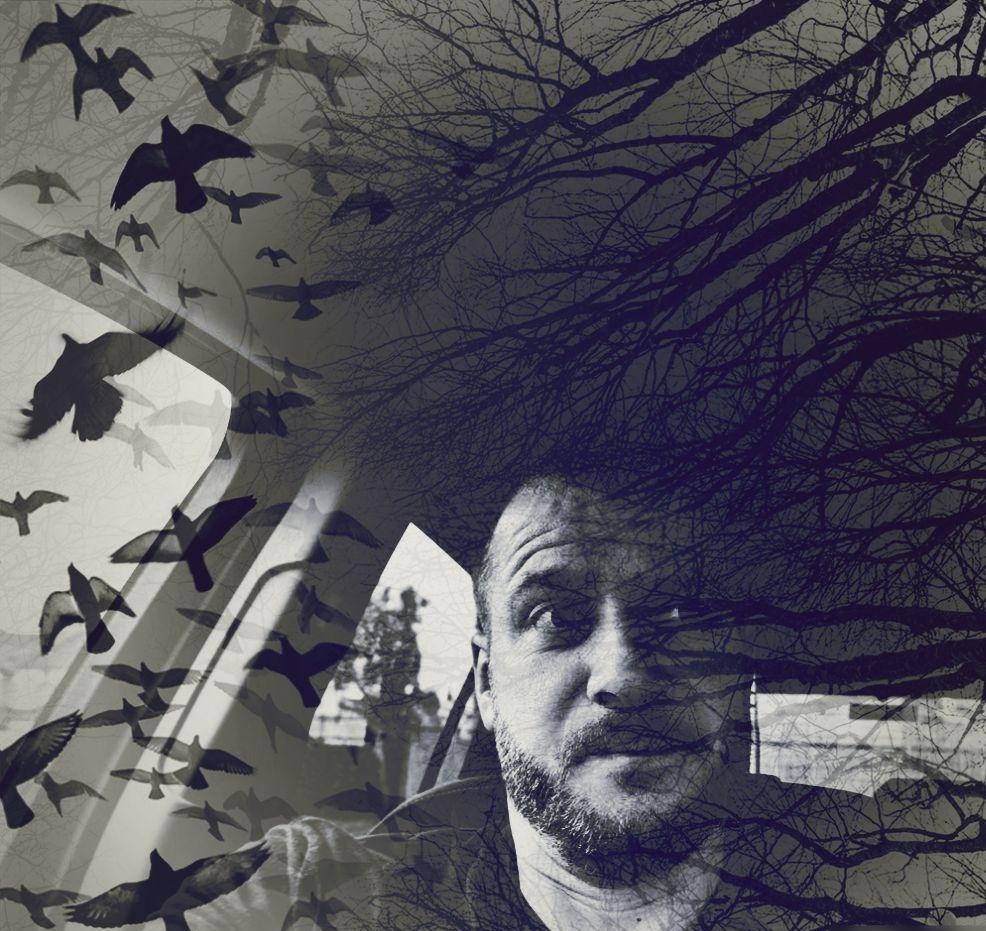
Who is Colm Field? Well, he was born in the witching hour, beneath a blood-red moon, and under a bad sign.
His first words were not fit to print. Now he scratches stories with yellowed fingernails, across the mouldering walls of the abandoned nuclear power station he calls home.
If you like what you read, we’ll dare you to find out more . . . 
PaperBound Magazine is an online magazine for the young, and the young at heart. We are dedicated to showcasing authors and illustrators for children’s and young adult fiction and we strive to deliver inspiring content, uplifting stories, and top tips for young and aspiring writers yet to burst on to the literary scene.

All our issues are completely free and run by volunteers, however if you would like to support PaperBound and the work we do, you can help us out by buying us a virtual book. We appreciate any support you can give us!

Don’t forget you can read with the latest issues of PaperBound Magazine – completely free – here.

article, Blog, Blog series, on writing, Writing craft

Guest Blog Post: Author of YA Dystopian novel ‘The Undying Tower’ Melissa Welliver shares her thoughts on Writing Alternate Histories

A lot of people don’t know this but I did a joint-honours degree, and my final year was weighted one quarter towards English Literature, and the other three quarters towards History. That meant I ended up doing my dissertation on the Tudor period, which led me to the works of my favourite Tudor: Sir Thomas More. If you don’t know Thomas More and you love dystopia, well, listen up, because he invented it. Or at least, he coined the entire usage of Utopia in the first place, letting future writers subvert it for their own nefarious needs (read: writing a really cool story).

Thomas More’s Utopia – a falsified account of his journey to a seemingly perfect country named, you guessed it, Utopia – was arguably about an imagined, perhaps hoped for, future about how Tudor England and the world could run if we looked to a fairer, brighter future. The clue is in the title, but the people of Utopia were happy, balanced, had no need for money, and well cared for. So is it any wonder that when we as writers look into these topics, we end up imagining the worst possible scenario instead, to really show a mirror to the world we live in and discover what we truly see as Utopia?

So what does all this have to do with alternate histories? Well, just as Thomas More wrote about an alternate past, we do much the same when worldbuilding our dystopian futures. Most dystopias take route in a big change, something familiar to our own world but knocked off its axis with a cataclysmic event. This can be a change in our own pasts, such as in The Man in the High Castle, which imagines a world in which the Nazis won. The Fallout TV series and games are set in an alternate future where the timeline changes drastically after World War Two, to include vacuum tube electronics as opposed to circuit boards. Despite the diverges in these timelines happening in the past, Dystopias often seek to reflect what many decades of human endeavour past these points looks like in the future – and more importantly to the reader, whether we can stop them coming into being.

In The Undying Tower, I was most interested in exploring overpopulation and its effect on climate change. Because I knew how important these themes were up front, I was able to find SFF ways to incorporate them into the book during the early planning process. My lovely friend Caroline passed away from cancer (Glioblastoma Multiforme) during the writing process, and that made me really quite angry. All I could think about was what it would be like to live in a world where people don’t get sick, cancer was gone, and people lived forever. Caroline was a big believer in the planet we lived on, and I know she too was worried about the effects of overpopulation on climate change. And thus, the central idea of the book was formed. A small sect of society, known as the Undying, that could survive illness and never die from old age – and therefore inadvertently create an even bigger population boom.

I knew I wanted to explore the accelerated effects of climate change after such a catalyst as the discovery of the Undying, so I knew I had to craft an alternate timeline where my book could take place. So despite being set in the future, I wanted it to take place decades into an overpopulation crisis, and see how that affected the world we live in now, to create my future one. I looked up flood maps for melted ice caps and food storage facilities in the UK. I even went on a trip to Chernobyl to fully understand the effects of nuclear power, especially on the environment when things go wrong (TLDR; the environment will eventually grow back, but the human outlook? Not great).

In essence, I truly believe that everything we learn about our history can help shape our futures. And writing alternate history can help writers explore broader themes in an evolved future, plus help readers to see the similarities in the world we live in. Writing alternate histories isn’t just for fiction – I hope it will help in reality, too.

Melissa Welliver is a shortlisted author specialising in YA fiction. In the genre, she has produced two dystopian rom-coms, My Love Life and the Apocalypse and Soulmates and Other Ways toDie.

The Undying Tower is her first book in a trilogy.Melissa writes speculative fiction about how the end of the world is never really the end of the world. After studying Creative Writing at the University of Manchester, she went on to complete Curtis Brown’s Creative Writing for Children course. Her work has listed in Bath Novel Award, Mslexia, the Hachette Children’s Novel Award and the Wells Book for Children Competition.

PaperBound Magazine is an online magazine for the young, and the young at heart. We are dedicated to showcasing authors and illustrators for children’s and young adult fiction and we strive to deliver inspiring content, uplifting stories, and top tips for young and aspiring writers yet to burst on to the literary scene.

All our issues are completely free and run by volunteers, however if you would like to support PaperBound and the work we do, you can help us out by buying us a virtual book. We appreciate any support you can give us!

Don’t forget you can read with the latest issues of PaperBound Magazine – completely free – here.

Blog, Blog series, Competition, on writing, Writing craft

Guest Blog Post: Branford Boase Award Judge, Christine Pillainayagam, on the 2024 shortlist

Brandford Boase Award 2024

When I wrote my debut novel Ellie Pillai Is Brown, I wrote it for me. Or more accurately, for 15 year old me. A girl who’d never seen herself – a brown, second generation, Catholic, Tamil immigrant – reflected in the world around her. Not in books or magazines or films or music. The places she looked to for comfort and guidance, never showed her a version of who she could be. Growing up, that feeling of invisibility, of not belonging, sticks. Like glue on the inside of a book spine, it forms a fundamental part of your structure.

Decades later, I sat down at my computer and a book began to pour out of me. I remember vividly the feeling of typing the first words onto a blank page – My name is Ellie. Ellie Pillai – and so my hero was born. Both me, and so much more than me, Ellie is a 15 year old brown girl caught between two cultures – a traditional Tamil upbringing with her family at home, and the life of a classic British teenager at school.

This story, loosely based on some of my own experiences as a music obsessed teenager growing up in a predominantly white area, is what the book industry describes as ‘own voice’ – meaning exactly that. A book written by an author with intimate knowledge and understanding of the material, because it is lived first hand.

As a debut author, taking an ‘own voice’ story into the world can be frightening. It can feel as if not simply your writing is being judged, but yourself and the validity and relevance of your experiences. I was told time and time again, by agents and publishers alike, that my story wasn’t really a story. That there wasn’t a ‘hook’ or a sense of jeopardy, yet to me, I felt the transformation of this shy 15 year old from someone determined to be invisible out of fear of racism, to someone with the courage to stand up and stand out, was a story needed by so many children today. Luckily, my brilliant agent and publisher agreed – and so did the judges of the Branford Boase Award who made me the winner of the prize in 2023.

Winning the BBA has had a profound impact on how I now view children’s stories and their importance in the world. The foundation they build in young people’s lives. The glue we create in their book spines. This year as a judge for the prize, I was delighted to see more ‘own voice’ stories being promoted by publishers. Books that speak to the reality of children’s lives and represent every version of who they are and who they could be.

With a longlist of 25 incredible books, my fellow judges and I had some spirited discussions about who would make the shortlist, but in the end, the word that comes to mind for all 6 shortlisted novels is ‘powerful’. Each one, through a mix of humour, joy, love, pain, fear, compassion, representation, felt powerful. Stories that stick with you long after you turn the final page.

Like the amazing You Think You Know Me by Ayaan Mohamud, which gripped the judges with its use of pace and tension as a terrible incident unfolds, and deals sensitively and beautifully with themes of racism, Islamophobia and microaggressions. Or the hilarious The Swifts by Beth Lincoln, a classic whodunnit full of twists and turns that has such a distinctive voice and is so cleverly layered with themes of identity and family that it becomes a celebration of individuality. The Jhalak Prize winning Safiyyah’s War by Hiba Noor Khan, a compassionate story full of heart, which taught us something we didn’t know, then made us want to learn more about it. The brilliant The First Move by Jenny Ireland, a YA love story with depth, that speaks openly and authentically about disability and covers themes from LGBTQIA+, to mental health and housing security. The outstanding The Final Move by Matt Goodfellow, a verse novel that draws you into a world so often unrepresented in children’s books – a hopeful, playful masterpiece.

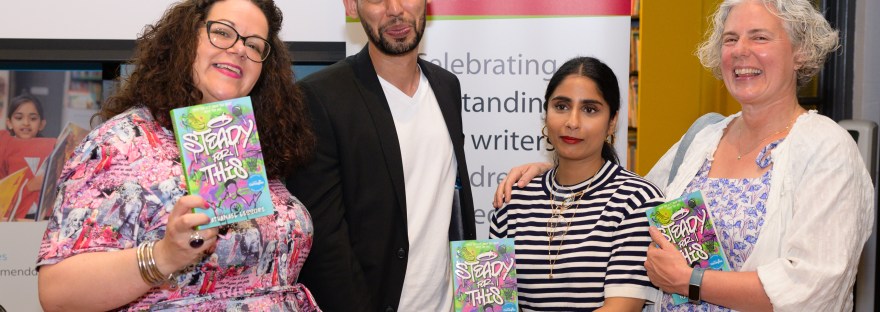
And of course, our wonderful 2024 Branford Boase Award winner Steady For This by Nathanael Lessore, a book of joy, emotion, light and shade. A story that confronts heavy subject matter in a life affirming and generous way. We wanted to push this brilliantly funny book into the hands of as many children as we could.

Each of these powerful novels represents the future of children’s books. One that is filled with hope and safety, whoever you are.

The Final Year Matt Goodfellow, illustrated by Joe Todd-Stanton, edited by Charlotte Hacking (Otter-Barry Books)

The First Move by Jenny Ireland, edited by Ruth Knowles with Sara Jafari (Penguin)

Safiyyah’s War by Hiba Noor Khan, edited by Eloise Wilson (Andersen Press)

Steady for This by Nathanael Lessore, edited by Ella Whiddett and Ruth Bennett (Hot Key Books)

The Swifts by Beth Lincoln, illustrated by Claire Powell, edited by Ben Horslen and Julie Strauss-Gabel (Puffin)

You Think You Know Me by Ayaan Mohamud, edited by Sarah Stewart (Usborne)

Brandford Boase Award 2024
Christine Pillainayagam was born in Norwich, grew up in Sheringham and attended school in Holt and Norwich. She now lives in Faversham in Kent.  She is a writer and retail strategist. A mild obsession with The Beatles and the desire to write a story that reflected her own experiences growing up as a first-generation immigrant led her to put that love of music and words into a book. Ellie Pillai is Brown features songs written by the protagonist, Ellie, and they are available to listen to via QR codes in the book. Ellie Pillai is Brown was shortlisted for the Waterstones Children’s Book Award and the Jhalak Children’s and YA Prize and won the 2023 Branford Boase Award.

PaperBound Magazine is an online magazine for the young, and the young at heart. We are dedicated to showcasing authors and illustrators for children’s and young adult fiction and we strive to deliver inspiring content, uplifting stories, and top tips for young and aspiring writers yet to burst on to the literary scene.

All our issues are completely free and run by volunteers, however if you would like to support PaperBound and the work we do, you can help us out by buying us a virtual book. We appreciate any support you can give us!

Don’t forget you can read with the latest issues of PaperBound Magazine – completely free – here.

Blog, Blog series, Writing craft

Guest Blog Post: Emily-Jane Clark on Writing Comedy, author of The Beasts of Knobbly Bottom series

“Can you write a joke about this building that looks like Donald Trump?” This was just one of random things I worked on when I was a TV comedy writer!

Before I was a children’s author, I wrote for television shows such as The Mash Report, Mock the Week and The Jonathan Ross Show, where I learnt a lot about joke-writing and how to use comedy to engage an audience, both of which were really useful when I started working on my funny series for children – The Beasts of Knobbly Bottom!

Writing jokes about feminism, politics, pop culture and parenting, may be very different to the humour in my The Beasts of Knobbly Bottom books but actually the process I use to come up with funny ideas is the same!

One of my favourite ways to come up with a comical situation is by using my ‘Wouldn’t it be funny if?’ technique. I will take an ordinary everyday occurrence or current issue and think of a way to make it silly, fun, or sometimes absurd! For instance, what if … toilets came alive and were really cross that people were weeing on them! Or, what if the King accidentally did a massive burp during his Christmas Day speech or even, as I put in my first book, wouldn’t it be funny if sheep turned into mean gangster vampires?

While it was a lot of fun creating comedy for grown ups, I find you can be even more bonkers when writing for children, which is one of the reasons I wanted to write a kid’s novel. That, and the fact I love a good bum joke, which tend to go down much better with under elevens…

Another form of humour I love to write is observational comedy – I did a lot of this for The Mash Report and the Daily Mash, so I really wanted to incorporate it into my books! As a mum of two young daughters, I realised that some of our discussions (OK, arguments!) are pretty funny. Children often try to find a loophole in their parents’ rules, think very literally or just be plain cheeky, and this can be hilarious. Therefore, I tried to include this in the relationship between my Knobbly Bottom mum character, Lucy, and her two daughters, Maggie, and Lily. It was important to me that their interactions were realistic and relatable and make parents laugh along with their children.

I love writing comedy for adults, but as a mother on a permanent quest to make her children laugh, and a massive kid at heart, creating Knobbly Bottom and all its weird and wonderful characters really has been a dream come true.

Emily-Jane Clark is a TV comedy writer, author and part-time drama teacher whose passion for stories and making children laugh inspired her to turn her hand to funny children’s fiction. She has written two books for children aged 8 – 11  THE BEASTS OF KNOBBLY BOTTOM: ATTACK OF THE VAMPIRE SHEEP and THE BEASTS OF KNOBBLY BOTTOM: RISE OF THE ZOMBIE PIGS (out on the 4th January).

PaperBound Magazine is an online magazine for the young, and the young at heart. We are dedicated to showcasing authors and illustrators for children’s and young adult fiction and we strive to deliver inspiring content, uplifting stories, and top tips for young and aspiring writers yet to burst on to the literary scene.

All our issues are completely free and run by volunteers, however if you would like to support PaperBound and the work we do, you can help us out by buying us a virtual book. We appreciate any support you can give us!

Don’t forget you can read with the latest issues of PaperBound Magazine – completely free – here.

Blog, Blog series, Interview, Interviews, Writing craft

Interview: Rebecca Barrow on YA Thriller ‘And Don’t Look Back’

Thanks for having me! And Don’t Look Back is a twisty thriller that centres on Harlow, a girl who has spent her entire life on the run. When her mother is killed in a car accident, Harlow is left to unravel the secrets of her life and her family all alone.. 

I really love writing about mothers and daughters, and I thought it would be interesting to explore generational trauma—how a girl like Harlow is shaped by her mother’s experiences, and how she deals with that while at the same time struggling to figure out who she is in the same way all teenagers do. I really enjoy writing older YA because that time in life is so interesting—you’re on the precipice on adulthood but still a kid, at the same time. And like Harlow, a lot of teenagers are dealing with really heavy things like the loss of a parent or mental health struggles or a million other things, and I think it’s important to acknowledge those things.

It took a while to come together but once the planning was done, the writing came quite easily. I usually don’t like to plan too much because I like discovering things through the writing, but often writing a mystery means you need to plan, so it’s about finding the right balance for me. Some of the plot aspects had been in my head for years just waiting for the right story so it really was a mix of long term planning and figuring some things out as I went!

Yes, I actually really do! I don’t think I will ever run out of ideas, but I do find they sometimes take a while to come to me. I’m definitely not one of those authors who have so many ideas that the main struggle is choosing which one to work on, but I think needing to let things develop in the back of my mind can also be really beneficial. I don’t see myself ever not writing. 

I write in twenty-minute blocks and use a program called Freedom to block the internet while I write, otherwise I would never get anything done. I usually have a word count goal so I just keep writing in those twenty minute slices with breaks in between until I have the words! I like to use different playlists for different books, to help me get in the right headspace, and that’s about it! 

I have mostly always wanted to be a writer but I did entertain the idea of several other careers—nurse, fashion designer, and choreographer were the big three! But it was mostly always writer for me.

Rebecca Barrow is the critically acclaimed author of And Don’t Look Back, Bad Things Happen Here, and several others.
She is a lover of sunshine, Old Hollywood icons, and all things high femme. She lives and writes in England.

PaperBound Magazine is an online magazine for the young, and the young at heart. We are dedicated to showcasing authors and illustrators for children’s and young adult fiction and we strive to deliver inspiring content, uplifting stories, and top tips for young and aspiring writers yet to burst on to the literary scene.

All our issues are completely free and run by volunteers, however if you would like to support PaperBound and the work we do, you can help us out by buying us a virtual book. We appreciate any support you can give us!

Don’t forget you can read with the latest issues of PaperBound Magazine – completely free – here.